
Author Archives: Chris Jordan

Who’s the Boss?

Proverbs 16:3 

“Commit thy works unto the LORD, and thy thoughts shall be established.” (KJV). 

The Secret to Success:

What is the secret to success? The world tells us that we just need to “be positive, focus, be persistent and work hard!” Is that all it takes? Or is there something else that we can do if we want to do well in life? Eugene Peterson paraphrases today’s Scripture with these words: “Put God in charge of your work, then what you’ve planned will take place.” (The Message). 

Here are two important keys from the Scriptures that will help your plans to come to pass: 

  1. Delight Yourself in the Lord:

Psalm 37:4 says, “Delight yourself also in the LORD; and he shall give you the desires of your heart.” If we want our thoughts to be established, and see our goals accomplished, the first thing we should do is spend time with God, and ask Him what His plans for our lives are. Too many Christians come up with their own ideas and plans and go to God and say, “Lord, will you bless my plans?” But those plans are not always His will for our lives, and so He may not bless them. 

One of my favourite comic strips characters Calvin, from Calvin and Hobbes went to his dad and said, “Will you buy me a flame thrower?” His response was, “No.” Does that mean that his dad didn’t love him? Of course not! But he knew his son well enough to know that if he gave into his request, it would have disastrous consequences. So, if we want to see our thoughts established, we must first spend time with the Lord and ask Him what He wants us to do. 

This is one of the reasons why the ministry of Jesus was so successful. He only did what the Father told Him to do! Jesus said, “The Son can do nothing of Himself, but what He sees the Father do.” (John 5:19). I was in ministry for several years before I learned this important principle: Instead of going to God with my plans and saying, “Would you bless them?” I now go to God and say, “What’s your plan for today, Father?” 

  1. Walk in Obedience:

If we want God to see our plans succeed, we need to walk in obedience to the Lord. The first part of that is obedience to the general will of God as recorded in the Scriptures. James 1:25 says, “But he who looks into the perfect law of liberty and continues in it, and is not a forgetful hearer but a doer of the work, this one will be blessed in what he does.” The second part is obedience to the specific will of God for our lives, which is revealed to us in prayer. God has blessed us to be a blessing – who does He want you to bless today? 

What is God calling you to do? Do it and it will be blessed!
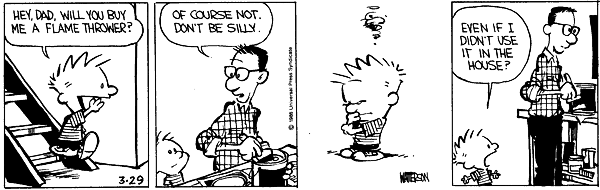
Calvin & Hobbes - flame thrower

(Calvin & Hobbes (c) 2013 Bill Waterson).


Purposes Established!

Proverbs 15:22

“Without counsel purposes are disappointed: but in the multitude of counsellors they are established.” (KJV). 

I love the Bible, and especially the book of Proverbs! There is so much practical wisdom for daily living in God’s Word. Someone described the Bible once using this acrostic: B.I.B.L.E. = Basic Instructions Before Leaving Earth. If the God who created the universe wrote a book, a detailed instruction manual for living life, then we would be wise to heed its advice.

In the above Scripture, Solomon tells us that there are many people who purpose or plan to do things but they are disappointed because of a lack of counsel. However, he says that there is wisdom in the multitude of counsellors. In other words, if you are trying to do something, don’t be so prideful that you try to do it yourself – get help! Seek wisdom and advice from others.

Towards the end of 2009, I had a dream to write a book. However, I had never written a book before. Sure, I had transcribed sermons and put together short little booklets and devotionals for our church family, but I had never written or published a full length book before. So, the first thing I did was I started talking to people. I got advice from writing buddies – from Wendy Neudorf, who is also a writer and blogger, who helped me edit my manuscript, to Nichole Forbes, my wife’s cousin who is also a writer and blogger. From their advice and that of many others – including words of wisdom I found in books and online blogs on writing – I began the task of writing a book.

In June of 2010, I published my first book – Supernatural: Contending for Signs and Wonders Today. I don’t believe my dream would have ever been fulfilled, nor would it have been as good as it was, without the advice and feedback from many wise and good friends.

As I pastor, I seek God’s wisdom and guidance on a regular basis concerning the mission and vision of our church family. I am so thankful for a great team of leaders that speak into my life and help me to make wise decisions concerning God’s church. I have our elders who pray together with me to discern God’s direction, and a church council who help me make decisions concerning our church finances and building use. It’s so true that there is wisdom in a multitude of counsellors! On our own, we have blind spots, weaknesses, and lack knowledge and experiences, and can greatly benefit from the wisdom and input of others.

The New Living Translation of the above Scripture says: “Plans go wrong for lack of advice; many counselors bring success.” Do you have a dream for your life, a goal or a plan that you want to accomplish? Talk to people about it. Get wisdom and counsel from people, from books, and of course ultimately from the Bible. Do this and you will see your purposes established!


Fire Words (15:1)

Fire Words

Proverbs 15:1

“A soft answer turns away wrath, But a harsh word stirs up anger.” (KJV).
“A gentle response defuses anger, but a sharp tongue kindles a temper-fire” (The Message).

Have you ever thought about how powerful your words are? Solomon tells us that “Death and life are in the power of the tongue.” (Prov. 18:21). Think about that for a minute. Every word you speak to someone can bring life or death to them. In the above passage of Scripture, we learn that our words can diffuse the most difficult fights or arguments. If we speak gentle words, we can turn away wrath. But if we respond with harsh words, we will only stir up that other person’s anger. We also learn here that gentle words can bring life and health to someone, and negative words can crush someone’s spirit.

James gives us a great word picture to help us see the power in our words when he writes: “The tongue is a small thing, but what enormous damage it can do. A tiny spark can set a great forest on fire. And the tongue is a flame of fire. It is full of wickedness that can ruin your whole life. It can turn the entire course of your life into a blazing flame of destruction, for it is set on fire by hell itself.” (James 3:5-6).

I think it’s interesting that James uses fire to represent the power of the tongue. Fire is a tool, and it can be used for either good or evil purposes. The same fire that can be used to cook your food or warm your house can also be used to burn down a building. Likewise, our words can be used to bring encouragement or comfort, or to bring death and destruction.

In his book, The Power of Your Words, Robert Morris gives three suggestions for how we can begin the process of taming our tongue.

  • Pause: Hold on there just a minute. Before you open your mouth, pause for a minute. James exhorts us to “be quick to listen, slow to speak, and slow to get angry.” (James 1:19). God gave us two ears and one mouth, so we should listen twice as much as we talk!
  • Ponder: Let’s give that some thought. The Bible says, “Don’t use foul or abusive language. Let everything you say be good and helpful, so that your words will be an encouragement to those who hear them.” (Eph. 4:29). If your words don’t fit into that category, then don’t say them!
  • Pray: Appeal to a higher power. If words are so powerful, then we should pray that God would give us the ability to tame our tongues. Let’s pray that God would set a guard over our mouths.

Control Your Anger

Proverbs 14:29

“He that is slow to wrath is of great understanding: but he that is hasty of spirit exalteth folly.” (KJV).
“Those who control their anger have great understanding; those with a hasty temper will make mistakes.” (NLT).

The Emotion of Anger

The Book of Proverbs gives us a smorgasbord of wisdom that applies to every area of our life: It gives us wisdom in our relationships, family life, dealing with finances and walking in righteousness. But it also gives us a window into our heart, and helps us to consider our emotions as well. In the above Proverb, Solomon addresses the emotion of anger.

Anger is not necessarily a bad thing. It is an emotion, and when we are treated unfairly, we are going to get angry. However, what we do with that emotion is what makes it good or evil. If we can control our anger, it proves that we have great understanding. But those with a hasty temper will make mistakes. I’ve seen people get angry and then do things that they later regretted, impulsive and often embarrassing mistakes. When we control our anger, we can avoid some of those blunders.

How do we control our anger?

So what is the antidote to a person who struggles with anger? It’s easy to say, “Stop being so angry!” But it’s another thing entirely to try to control those emotions in your own life. What is the answer then? I believe it’s found in a letter that the Apostle Paul wrote to a church in Galatia. He starts out by identifying the problem: “When you follow the desires of your sinful nature, your lives will produce these evil results: sexual immorality, impure thoughts, eagerness for lustful pleasure, idolatry, participation in demonic activities, hostility, quarreling, jealousy, outbursts of anger, selfish ambition, divisions, the feeling that everyone is wrong except those in your own little group, envy, drunkenness, wild parties, and other kinds of sin. Let me tell you again, as I have before, that anyone living that sort of life will not inherit the Kingdom of God.” (Gal. 5:19-21). He then gives the solution: “But when the Holy Spirit controls our lives, he will produce this kind of fruit in us: love, joy, peace, patience, kindness, goodness, faithfulness, gentleness, and self-control.” (Gal. 5:22-23).

How do we get more of this fruit of the Spirit in our lives? Spend time with Jesus in prayer! Jesus said, “Abide in Me, and I in you. As the branch cannot bear fruit of itself, unless it abides in the vine, neither can you, unless you abide in Me. I am the vine, you are the branches. He who abides in Me, and I in him, bears much fruit; for without Me you can do nothing” (John 15:4-5).

Lord, help us to abide in the secret place of prayer, abiding in Jesus the Vine, so we can bear the fruit of the Spirit in our lives. Amen!


Just Reward

Proverbs 14:14.

“The backslider in heart shall be filled with his own ways: and a good man shall be satisfied from himself.”

Christian Karma?

There are many religions in the world who believe in karma. Hindus, Buddhists and Sikhs for example all believe in the concept of “action” or “deed”, that which causes the entire cycle of cause and effect. In other words, if you are a good person, good things will happen to you, and if you are a bad person, bad things will happen to you. You might be surprised to learn that this idea actually has its origins in the Bible. King Solomon wrote: “Backsliders get what they deserve; good people receive their reward.” (Prov. 14:14, NLT).

Now lest some of you begin calling me a heretic for suggesting that karma is a Christian concept, let me clarify. Karma is a twisted and imperfect understanding of the Scriptural principle of reaping and sowing which the Apostle Paul describes here: “Don’t be misled. Remember that you can’t ignore God and get away with it. You will always reap what you sow! Those who live only to satisfy their own sinful desires will harvest the consequences of decay and death. But those who live to please the Spirit will harvest everlasting life from the Spirit.” (Galatians 6:7-8, NLT).

Consequences for our Actions:

Today’s Proverb teaches us that there are consequences for our actions. If you are a backslider, you will get what you deserve. If you live a life of sin and rebellion against God and His Word, don’t be surprised when life doesn’t work for you! But if you are a good person, and live to please the Spirit, you will receive a blessing from the Lord.

Let me illustrate. My dad was an alcoholic womanizer. He slept with many women in his life, and as a consequence, I have two sisters, two half-sisters, and at least three half-brothers that I know about (maybe more). My dad died about five years ago from a cancer that was caused from his excessive drinking and cigarette smoking. Sadly, this is an example of reaping what you sow.

Sometimes we live a sinful life and then experience the consequences for that sin, and we get mad at God and say, “How could you let this happen to me?” But it wasn’t God punishing us for our wrong decisions, but rather leaving us to the just reward of our own choices.

A Harvest of Blessing:

The good news today is that God is a merciful, gracious God. All of us have sinned, rebelled, and disobeyed His commandments, but we can confess our sins to Him and receive His free forgiveness. In Paul’s letter to the Galatians, he added an action plan for all of us. In light of the fact that there are consequences for our choices, he says, “So don’t get tired of doing what is good. Don’t get discouraged and give up, for we will reap a harvest of blessing at the appropriate time.” (6:9, NLT).


Two Roads

Proverbs 14:2.

“He who walks in his uprightness fears the Lord, But he who is perverse in his ways despises Him.” (KJV).
“Those who follow the right path fear the LORD; those who take the wrong path despise him.” (NLT).

The Road Not Taken by Robert Frost:

  • I shall be telling this with a sigh,
  • Somewhere ages and ages hence:
  • Two roads diverged in a wood and I –
  • I took the one less traveled by
  • And that has made all the difference 

Often, the references to roads in poetry are metaphors to make us think of our lives and how we live them. Even Jesus used this metaphorical sense in talking about roads when He said, “Enter by the narrow gate, for wide is the gate and broad is the way that leads to destruction, and there are many who go in by it. Because narrow is the gate and difficult is the way which leads to life, and there are few who find it.”  (Matthew 7:13-14).

Everyone wonders: how do we find the road to the blessed life?  Jesus said that this road is the road less traveled by – that there are few who find it – and that it will make all the difference, for this is the road that leads to life. I believe this is what Solomon was talking about in the above Proverb:

The First Road – The Wrong Path:

The first road that Jesus talks about is the wide road that leads to destruction. He says there are many people who walk on that road. Proverbs 14:2 says that those who are perverse in their ways – those who take the wrong path – show that they despise God by walking on this road. It’s like God put up a big sign that said, “Abandon hope all ye who enter here” and yet foolish people still choose that road. The road of sin, rebellion, and ultimately death. But there is another road…

The Second Road – The Right Path:

The second road that Jesus talks about is the narrow and difficult way that leads to life. He says that – sadly – there are few who find this road. Proverbs 14:2 says that those who walk in their uprightness – those who follow the right path – fear the Lord. And here is the key to walking on the right path. It starts with a fear of the Lord.

To fear the Lord doesn’t mean that we are afraid of Him. However, it does mean that we respect Him, and when He says, “This is the way, walk in it,” we obey. Because we trust Him. And we know that the commands that He gives to us are for our own good.

Today, you are standing at a crossroads. Two roads diverge in a wood. The highway to hell is broad, and its gate is wide for those who choose the easy way. But the road to life is small, and the road is narrow, and only a few find it. Take the narrow road – the road less traveled by. It will make all the difference in your life!


Attaining Dreams

Proverbs 13:19.

“The desire accomplished is sweet to the soul: but it is abomination to fools to depart from evil.” (KJV).

If I Believe It, I Can Achieve It?

There was a popular song by R&B singer R Kelly from 1996 called “I believe I can fly.” It hit the number two spot on the Billboard Hot 100. The song boasted, “If I can see it, then I can do it, if I just believe it, there’s nothing to it… I believe I can fly.” Really? If I can see something then I can do it? All I have to do is believe it and I can achieve it? I don’t think so!

Now don’t misunderstand what I’m saying here. I’m all for being positive, but just because you want something doesn’t mean it’s going to happen. I can have a desire to be the best basketball player in the history of the world – rival to that of Michael Jordan – but that doesn’t mean it’s going to happen.

Think about it for a minute: What kid hasn’t dreamed of being able to fly like Superman? As a child, I remember donning a red cape and leaping off of the diving board into the swimming pool, but the end result was always the same: I got wet. (Fortunately, unlike some foolish daredevils, I never tried this feat off of the top of a roof!).

Put Your Dream to the Test:

A couple of years ago I was preparing to write my first non-fiction book Supernatural: Contending for Signs and Wonders Today. When I sat down to accomplish my goal of writing and publishing my first book, I came across an excellent book by John Maxwell called Put Your Dream to the Test. John Maxwell says that the difference between a dreamer and someone who achieves a dream lies in answering ten powerful questions.

One of Maxwell’s questions included The Cost Question: “Am I willing to pay the price for my dream?” That question made me think of our Scripture in Proverb 13:19: “It is pleasant to see dreams come true, but fools will not turn from evil to attain them.” (NLT). When your desire is accomplished, it is sweet to the soul. But a fool isn’t willing to pay the price – turn from evil – to achieve his dreams.

To Accomplish Your Dreams:

The Bible says God “is able to do exceeding abundantly above all that we ask or think, according to the power that works in us.” (Ephesians 3:20). God wants us to dream big dreams! But, if we want to see those dreams come true, we must be willing to do what it takes to accomplish them.

When I wanted to finish writing and publishing my first book, I set a goal for myself to write a minimum of 15 minutes a day until I was finished. Quite often, those 15 minutes ended up being much longer, but I had a goal and I stuck with it, and saw my dream become a reality. If you’re willing to put God first in your life, you can see your dreams realized, too.


Dream Big!

Proverbs 13:12

“Hope deferred maketh the heart sick: but when the desire cometh, it is a tree of life.” (KJV).
“Hope deferred makes the heart sick, but when dreams come true, there is life and joy.” (NLT).

When Hope is Deferred

Have you ever wanted something really bad or prayed about something for a very long time, but it never happened? Everyone has stories that they could share about disappointment and grief over things that they hoped for that never happened. When hope is deferred – when something you want doesn’t happen, or it doesn’t happen as quickly as you want it to – your heart gets sick. Hope deferred can cause you to stop hoping, stop dreaming, and even stop praying.

About ten years ago, my step-father lost his battle with cancer and he died. When that happened, my mom stopped praying. For many years, she refused to pray for circumstances to change, because she feared that they would only get worse. I am thankful that things have changed, and that she’s praying again today. Too many Christians allow themselves to get heart sick and then they lose courage, give up, and eventually they die.

“But”

The key to understanding God’s purpose in this Proverb is found in the small but important little word “But.” When I was an adjunct professor at Pacific Life Bible College in Surrey, BC, I always taught my Bible Research students to look for those key connective words. There is an example of this in Ephesians chapter two where the Apostle Paul talks about how we “were by nature children of wrath… But God, who is rich in mercy, because of His great love with which He loved us (has) made us alive together with Christ.” (v. 3-5).

So, although it is true that hope deferred can make our hearts sick – But God – His desire is that we would dream, and dream big. For when those dreams are finally realized, there is life and joy. Thank God for the big “buts” in the Bible!

When Dreams Come True

Also in Ephesians, Paul tells us that God “is able to do exceeding abundantly above all that we ask or think, according to the power that works in us.” (Ephesians 3:20). Our God is a good God, and He loves His children very much. He longs to bless us, to care for us, and meet all of our needs. But so often, we never ask. I wish we as Christians would believe the Bible more than we do!

Jesus Christ Himself taught, “Therefore I say to you, whatever things you ask when you pray, believe that you receive them, and you will have them” (Mark 11:24). Do you believe the promise? If you do, then pray! If you are in trouble, call upon the name of the Lord, for He is mighty to save! And when the Lord answers your prayers, make sure you praise Him. “to Him be glory in the church by Christ Jesus to all generations, forever and ever. Amen.” (Eph. 3:21).