Category Archives: Wisdom

Your Position, Thought Out

The discretion of a man deferreth his anger; and it is his glory to pass over a transgression. –Proverbs 19:11 KJV

For normal, every day people, it is important to remember that most people are acting out of fear. Therefore, do not take attacks (verbal, physical, emotional) personally.

Put yourself in their position, and you might see there is no need to be angry.

If you are unable to change things (politics, entertainment, some circumstances), holding onto pain or offense hurts nobody but you.

Put yourself into a position to change things or avoid them.

If you are a Christian, you must realize that most attacks are either those briefly discussed above or are attacks against the One who lives in you, Jesus.

You are in a position of honor, suffering as your Lord.

Forgive them. You may be the one who wins them to the Lord.


Having the Grandeur to Forgive and Forget

Hold your tongue

Hold your tongue

Holding my tongue is easier said than done some days. Someone says something and off I go. I react. I speak. I regret it.

God’s wisdom teaches me to pause. I should forgive what they say. I should forget what they say. Many times we forgive but we don’t forget.

If I can forget it, I am truly liberated and free.

His wisdom teaches me to pause. Rather than respond I need to forgive first. Then I need to forget. Then I have nothing left to say about the offense that started everything to begin with.

God’s goal for me is that I know how to hold my tongue.

Smart people know how to hold their tongue; their grandeur is to forgive and forget.

Proverbs 19:11 (The Message Bible)

Forgiveness is also an essential part of the life of disciples of King Jesus.

Ephesians 4:32 commands, “Be kind and compassionate to one another, forgiving each other, just as in the Messiah God forgave you.”

Similarly, Colossians 3:13 says, “Bear with each other and forgive whatever grievances you may have against one another. Forgive as the Master forgave you.”

The key in both passages is that we are to forgive others as God has forgiven us.

Why do we forgive? Because we have been forgiven!


Don’t kill the mockingbird (just shut him up)

tree-46766_1280I’m sitting on the back porch as the birds herald in the morning when I hear the cat-bird.  Yea, he’s back!  I love that odd avian sound truly mimicking a cat. 

Oh, wait.  Now I’m hearing a jumble of sounds (including the cat-bird’s) all mixed together, all different.  There seems to be a cacophony of twitters all coming from the same bird in rapid fire succession.  It’s still pretty dark, so I can’t see the perpetrator, but it’s got to be a mockingbird—that strange creation that can’t seem to find a voice of its own.  Continue reading


Tickets, please.

airplane-2619434_1920I love to fly.  I’ve been in jets, small private planes, and even a free-float hot air balloon.  Something birds take for granted, I suppose, but for me, being up in the air is exhilarating. 

I’m not a pilot, however, so I reap the benefit of their knowledge and expertise.  My oldest brother is a pilot and has a couple of small aircraft up in Minnesota.  One year when visiting up there, he took me up for a look-see around the area with all those beautiful lakes and lush countryside.  We took off and landed on a dirt runway, and he even let me take control to actually “fly” the plane. 

That lasted about ten seconds while I freaked out.

He also told me not to worry, but since my door was partially open, and would I please full it shut and latch it?  Sure, no problem.

I still love flying. Continue reading


Interpreting a Proverb

I am going to do something a little different – I’m going to ask you to do some investigative work.

Please read the following verse from the King James Version of the Bible, then think about what it means.

Don’t look at another translation just yet. Don’t do anything other than read the following verse:

A gift is as a precious stone in the eyes of him that hath it: whithersoever it turneth, it prospereth. – Proverbs 17:8 KJV

What is it talking about?

Is the meaning obvious to you? What first impression do you get when reading it?

Quickly! Leave a comment below as to your first thoughts, then go do your research and leave a second comment.

Don’t cheat! The eyes of the Lord are watching 😉


What’s on your summer reading list?

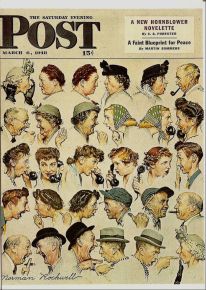
gossip

Another insightful painting by beloved Norman Rockwell.

Bob and I were watching a really interesting TV show on the top 100 popular books.  Now, how they came up with that short list, I don’t know, and it ranged from John Bunyan’s Pilgrim Progress to modern day novels that have influenced people in, well, other ways.

One of the neat things about this program is that it’s interactive, meaning you go online and cast your vote for your favorite book (among the short list, naturally), and you can vote once a day until the show’s finale.  Which means you can stuff the ballot box, I suppose. 

During the show, different people were interviewed on their Number One choice, and I was impressed how this divergent sampling of human effort has influenced individuals, and in some cases, greatly.

Like me.  One of John Bunyan’s other books, Grace Abounding to the Chief of Sinners, was my door to deliverance in a very real way.  But that’s another story, and anyway, I doubt that’s on the list.

The point is that words, or communication of any sort, are powerful.  That includes not only what we put out but just as importantly, what we take in.  In Proverbs chapter 15, information transfer of some sort is mentioned at least fourteen times!  And they didn’t even have social media yet!  Here’s an example of output:

“The tongue of the wise makes knowledge appealing,
    but the mouth of a fool belches out foolishness.”

Most of us have probably been party to both—my hand is raised.  What we perhaps don’t emphasize enough is the personal responsibility of intake:

“Plans go wrong for lack of advice;
    many advisers bring success.”

What I choose to listen to (or read) is actually just as important as what I choose to say (or write, as it were.) We all know the damage done by slurs on social media.  But do we realize that the damage is done not only because those things are put out there, but because they are read? In other words, the reader is just as culpable as the writer.  Always.

I know that I can be quite impacted by stories, mental images both from descriptive writing and the silver screen.  It’s the way we are wired, since the word (lower case “w”) is powerful, being created so by God Himself.  Therefore, what I choose to listen to is also powerful decision.

Sometimes earplugs are a good investment. 

president-1822449_1920

Proverbs 15: 2,22 Holy Bible, New Living Translation, copyright © 1996, 2004, 2015 by Tyndale House Foundation. Used by permission of Tyndale House Publishers, Inc., Carol Stream, Illinois 60188. All rights reserved.


Instructionless Brutes

It might be nearly the end of the week, and one might think we’d already gotten past the first verse of the chapter, but Proverbs 12:1 stood out to me this morning, and I’d like to tell you why.

Whoso loveth instruction loveth knowledge: but he that hateth reproof is brutish. – Proverbs 12:1

There are a lot of people who feel like there is no need for preachers, teachers, instructors, professors, or pastors. I read their comments any time I write something having to do with the ministry and ministry needs.

Often, and usually with poor spelling and grammar, the irate and biblically-illiterate employ arrogant language and out-of-context verses to “prove” their point. Consider a brief excerpt I copied from one particular conversation…the write goes by the name of Paradox7:

I don’t need an operator to call my LORD , and I have been reading the Bible since I was a child , don’t need an interpreter either…

Jesus actually spoke of wolves in sheep’s clothing , referring to religious leaders of his time , the same people who set him up for murder because he asurped their authority .If you have read the Bible , you can’t really disagree with that sentiment… It is a common bibical theme to be wary of authority figures , but of course many do not get the message , even as Jesus predicted ” for wide is the gate that leads to destruction , and there are many who will walk thru it .”

There is more to being instructed than simply reading the Bible. Many people do that, just like the Ethiopian Eunuch who asked Phillip in Acts 8:31, “How can I [understand], except some man should guide me?”

Godly teachers are a gift from God to the Church (Ephesians 4:11). Some people need them more than others.


All About Integrity

Proverbs chapter eleven is all about integrity.

What does inegrity entail?

Honesty

Telling the truth and doing what’s right is important. Honesty is life-affirming, acknowledging the image of God in others, and, honestly, keeping life simple. It is easier to keep your story straight when you tell the truth and do what’s right.

Responsibility

Doing what’s right, doing what one ought, is also life-affirming. Sin is most often associated with what we did wrong, but it includes what we don’t do that we should. If we did what was needed when it should be done (right away or when time allows), life would be easier. Owning mistakes is included, as growth comes more quickly. It is irresponsible to shift the blame or hope “someone else will do it.” It is better to do what is right, even if someone else could or should do it.

Generosity

Giving to others or taking up the burden of another demonstrates generosity. And – you probably guessed it – it is life affirming. It shows love to others. It tells others “You are worth it.” It clears up problems before they even exist or before they are out of control.

Living with Integrity

If you want to live with integrity, live out the concepts of Proverbs. Take five minutes and read the entire chapter and see how integrated and interrelated all of these concepts are.

They represent God’s character, and living with integrity makes your character more like His.

“Be perfect as your heavenly Father is perfect.” (Matthew 5:48)


Am I Willing to Take Orders?

Image result for proverbs 10 8I live in a world where I must respond to others and take orders. I have customers, colleagues, bosses, police, parents, teachers and the list goes on.

“A wise heart takes orders; an empty head will come unglued.” ~~King Solomon (Proverbs 10:8)

I do have options though.

  • I can ignore the person and hope they forget. Sometimes they do.
  • I can be obstinate.
  • I can be defiant.
  • I can say yes and then not do it.
  • I can fake obedience.
  • I can get too busy.
  • I can forget.

I can be too clever some days at avoiding the real issue of simple obedience.

It is a matter of the heart. Do I have a heart that respects authority? Am I willing to serve others? Do I have a slave’s heart for what my Master Jesus wants me to do?

If so, I can be wise.

Do I come unglued when someone in authority asks me to do something? King Solomon concludes I have an empty head. As my dad would say, “That is not right bright”.

God’s goal for me for is to obey. It is most important to obey Jesus. Jesus teaches me to pray, “Your will be done!”


Apostolic vs. Appropriated

Two ladies call out to the world in Proverbs 9: Wisdom and Folly.

The difference is actually striking.

[Wisdom] has sent her young women to call from the highest places
Proverbs 9:3

Wisdom sent her followers to the high places, the important places, to call to others.

Did you know the Greek word for “sent” is apestalmena, where we get the word for apostle: one who is sent?

Now look at Folly:

[Folly] takes a seat on the highest places
Proverbs 9:14

Folly takes the highest place, the most important place.

What Is the Difference?

When done apostolically, there is humility. Wisdom does not assume superiority (even when true) over other others but serves others.

Folly assumes superiority and appropriates what is neccessary – takes the important places, often by force and/or deception. There may be a false humility that can be attractive to others, but the true motivations tend to be selfish.

“When you are invited by anyone to a wedding feast, do not sit down in the best place, lest one more honorable than you be invited by him; and he who invited you and him come and say to you, ‘Give place to this man,’ and then you begin with shame to take the lowest place. But when you are invited, go and sit down in the lowest place, so that when he who invited you comes he may say to you, ‘Friend, go up higher.’ Then you will have glory in the presence of those who sit at the table with you. For whoever exalts himself will be humbled, and he who humbles himself will be exalted.”
Luke 14:8‭-‬11, NKJV