
Tag Archives: Words

Out of the Heart …

A man’s belly shall be satisfied with the fruit of his mouth; and with the increase of his lips shall he be filled.

Death and life are in the power of the tongue: and they that love it shall eat the fruit thereof. -Proverbs 18:20-21 KJV

A quick read-through of verse 20 had me thinking of a salesman, making sales with his smooth talking and eating from the work of his mouth (by buying food).

Then I thought about it longer than a couple of seconds.

Well Said

A person is satisfied by speaking well of and to others. When a person uses their words to lift up, praise, and edify another – especially by sharing the gospel – there is a satisfaction that fills every part of the body. (Also, church potlucks!) And this comes out of the love of God within us.

But when we do not have God’s love compelling us, all sorts of evil easily flows out, and that usually (and ultimately) leads to receiving the same.

And [Jesus] said, “That which cometh out of the man, that defileth the man. For from within, out of the heart of men, proceed evil thoughts, adulteries, fornications, murders, Thefts, covetousness, wickedness, deceit, lasciviousness, an evil eye, blasphemy, pride, foolishness: All these evil things come from within, and defile the man.”
Mark 7:20‭-‬23, KJV

We need to have our hearts and minds changed by the power of Christ’s blood washing us clean. Then our words shall become sweet and evidence the change.

Shut Your Mouth!

A fool’s lips enter into contention, and his mouth calleth for strokes. – Proverbs 18:6

Let’s be real, OK? Sometimes people get into trouble because they can’t shut their mouths.

Years ago, while driving a school bus in Kentucky, I had to stop and have the police come on board to search for drugs. As we had been going down the road there were some kids in the back who had lit up a marijuana joint and the smell was obvious.

However, when the police came onto the bus and began to search the bags of the suspected teens, a young girl who was sitting nowhere near the smokers started cursing at the police. Her complaint was that the suspected teens were black, that they were just being profiled, and that she wasn’t going to stand for it.

Needless to say, before long the one who ended up getting taken off the bus in handcuffs was the loud-mouthed, belligerent, unruly white girl. The other kids – the ones who said “Yes, sir,” and “No, sir” – just got a warning… no drugs were found.

What happened on that bus that day is nothing unusual; it happens all the time. Foolish people can’t help but run their mouths whenever they feel wronged or disrespected. Then, when strokes come, they act surprised.


What’s on your summer reading list?

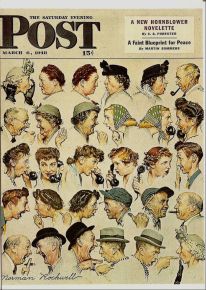
gossip

Another insightful painting by beloved Norman Rockwell.

Bob and I were watching a really interesting TV show on the top 100 popular books.  Now, how they came up with that short list, I don’t know, and it ranged from John Bunyan’s Pilgrim Progress to modern day novels that have influenced people in, well, other ways.

One of the neat things about this program is that it’s interactive, meaning you go online and cast your vote for your favorite book (among the short list, naturally), and you can vote once a day until the show’s finale.  Which means you can stuff the ballot box, I suppose. 

During the show, different people were interviewed on their Number One choice, and I was impressed how this divergent sampling of human effort has influenced individuals, and in some cases, greatly.

Like me.  One of John Bunyan’s other books, Grace Abounding to the Chief of Sinners, was my door to deliverance in a very real way.  But that’s another story, and anyway, I doubt that’s on the list.

The point is that words, or communication of any sort, are powerful.  That includes not only what we put out but just as importantly, what we take in.  In Proverbs chapter 15, information transfer of some sort is mentioned at least fourteen times!  And they didn’t even have social media yet!  Here’s an example of output:

“The tongue of the wise makes knowledge appealing,
    but the mouth of a fool belches out foolishness.”

Most of us have probably been party to both—my hand is raised.  What we perhaps don’t emphasize enough is the personal responsibility of intake:

“Plans go wrong for lack of advice;
    many advisers bring success.”

What I choose to listen to (or read) is actually just as important as what I choose to say (or write, as it were.) We all know the damage done by slurs on social media.  But do we realize that the damage is done not only because those things are put out there, but because they are read? In other words, the reader is just as culpable as the writer.  Always.

I know that I can be quite impacted by stories, mental images both from descriptive writing and the silver screen.  It’s the way we are wired, since the word (lower case “w”) is powerful, being created so by God Himself.  Therefore, what I choose to listen to is also powerful decision.

Sometimes earplugs are a good investment. 

president-1822449_1920

Proverbs 15: 2,22 Holy Bible, New Living Translation, copyright © 1996, 2004, 2015 by Tyndale House Foundation. Used by permission of Tyndale House Publishers, Inc., Carol Stream, Illinois 60188. All rights reserved.


Safely across to dry ground

buckley

The Mighty Wonder Buck enjoying his outing.

Buckley and I enjoy terrain hiking in a tiny semi-secluded patch of the planet belonging to the college where my husband works.  It’s private land, so I’m thinking the town’s leash laws are not in effect. It’s also one of the few places I can let him range, and he loves it!

So do I.  Not only for myself, but I get such a kick out of watching him enjoy the freedom, and I marvel at the sure-footedness of this rescue pound-puppy of ours.  Not that I can say that about myself, mind you.  No, this one carries a walking stick, wears special insoles in trail running shoes (in which I walk, not run), and even then I have to pick carefully through leaves and creek beds, using that opposable thumb to grab and hoist myself up the hills.

Buckley, the barefoot creature without the opposable thumb?  Right.  He leaves me in the dust. 

I have to be especially attentive when crossing a brook.  Picking my way safely can be challenging (it’s part of the fun), and watching for slippery moss on the rocks is imperative.  If I’m not careful, I’m all wet. 

Hold that thought for a sec.

Proverbs chapter ten is largely concerned with my words, which is a pretty good indicator of what’s in my heart.  Here is a running commentary contrasting the attitude (as shown by their words) of the wise person versus the fool.  Just a sampling—

The wise are glad to be instructed,
    but babbling fools fall flat on their faces…

People with integrity walk safely,…

This isn’t just an observation, (Solomon was quite good at that), but more importantly, a warning.  It’s easy to be drawn into a foolish argument; that is, an argument that is void of the primary foundation of wisdom—

“Fear of the Lord is the foundation of wisdom.
    Knowledge of the Holy One results in good judgment.”

Without this, the encounter can become slippery at best, treacherous at worst, causing confusion, rancor, and division (to name a few.)

Here’s another comparison—

The words of the godly are a life-giving fountain;

…but the babbling of a fool invites disaster.

Are my words giving life?  Or are my words making safe passage unattainable?

Or is it a discussion I should even enter into at this place?

When one of these conversations presents itself, the godly participant does well to stand on the shore and survey how to get across safely to the other side. 

Otherwise, you’re all wet.

Proverbs 10:8,9,11,14; 9:10 Holy Bible, New Living Translation, copyright © 1996, 2004, 2015 by Tyndale House Foundation. Used by permission of Tyndale House Publishers, Inc., Carol Stream, Illinois 60188. All rights reserved.


Fast Talk

Proverbs 29:20 

Seest thou a man that is hasty in his words? there is more hope of a fool than of him.
There is more hope for a fool than for someone who speaks without thinking. (NLT) 

The problem with words issued in haste is that they cannot be withdrawn. In this day and age the warning in this proverb should also apply to email. I speak from experience. Several years ago I hit the send button on an email I thought I was forwarding, without checking the email properly, or considering what I had written. I was frustrated with a certain Swedish individual by the name of Lennart who had just informed that he would be unable to translate a couple of documents for at least two weeks. These documents were vital to a report I was required to submit in less than two weeks. In my frustration, I forwarded the email to my boss with the comment; ‘Lazy Lenny says he can’t translate our statements!”

To my surprise, I received a reply almost immediately. Incredibly it was not from my boss but from Lazy Lenny. I couldn’t understand how he had accessed my email, but I felt my face starting to glow and radiate extreme amounts of heat as I read the words; “I am not Lazy Lenny sitting on the beach all day drinking beer!” Various excuses as to why he could not translate the documents sooner were also included. When I looked through the email more carefully I realized my error. I had hit the reply button instead of forward.

My email did spur Lazy Lenny into action and I had my translations later that day, but the point is that I wrote words that were rude in haste. I learned a massive lesson that day: The wisdom of Scripture is as important in our modern electronic age as it was thousands of years ago.

But most of all, my brothers and sisters, never take an oath, by heaven or earth or anything else. Just say a simple yes or no, so that you will not sin and be condemned. (James 5:12 NLT)


Flattery or Favour?

Proverbs 28:23

“He that rebuketh a man afterwards shall find more favour than he that flattereth with the tongue.” (KJV).

Love Languages:

One of my favourite books is one called The Five Love Languages by Gary Chapman. In this book, he talks about how people give and receive love in five main different ways: Words of affirmation, Acts of service, Receiving gifts, Quality time and Physical touch. It was a very practical, useful teaching because my wife and I have different love languages. Mine is words of affirmation, and hers is receiving gifts. The challenge came when I would want to communicate love with her, and I would use words of affirmation, but that didn’t translate well for her. When I discovered that her love language was receiving gifts, I found it much easier to communicate love to her in a way that she would understand it.

So my love language is words of affirmation. More than a gift, any act of service, time spent or physical touch, the best way to communicate love to me is through words. That’s why I may not get excited about a gift, but when someone sends me a card, letter or an e-mail with words of affirmation in it, I feel loved. However, there is a big difference between affirmation and flattery.

Affirmation or Flattery?

Have you ever had someone flatter you? Flattery is defined as “excessive, insincere praise.” As much as I enjoy genuine words of affirmation, there is nothing more annoying to me than fake words of flattery. And although I don’t like being rebuked or corrected either, I would rather have someone be honest with me and tell me what they really think.

Loving Rebuke:

If you really love someone, then when you see that they are getting off into trouble, or doing something that might hurt themselves or others, you will challenge and rebuke them. And believe me, I don’t enjoy this anymore than you do! I don’t like confrontation, but if I truly love my friends, then I need to be willing to bring rebuke or correction when they need it. They may not like it initially, but as Solomon says, “He who rebukes a man will afterward find more favour.”

Matthew Henry describes this well in his excellent Bible commentary: “He that cries out against his surgeon for hurting him when he is searching his wound will yet pay him well, and thank him too, when he has cured it.”

If a friend brings you a rebuke or a criticism about your behaviour, do a quick search and see if there’s anything to what they have to say. And, if what they are saying is true, humbly be quick to repent and change your behaviour. Then make sure you thank your friend for their loving concern for you and your well-being. If you see one of your friends getting off into trouble, make sure you speak the truth in love to them as well, and when you do, you can rest assured that sooner or later you will find their favour. They will appreciate your honesty!


The Praise Test

Proverbs 27:21.
“As the fining pot for silver, and the furnace for gold; so is a man to his praise.” (KJV).
“Fire tests the purity of silver and gold, but a person is tested by being praised.” (NLT). 

Student Writing

The Purpose of the Test:

I don’t know of anyone who enjoys tests. I have three children in high school and one child in middle school, and none of them have ever expressed a joy about having to take a test. I’ve never heard one of them come home from school and say, “Dad, I’m so excited, we get to take a test at school tomorrow! I’ll have to study all night. Awesome!” But like it or not, if they were never tested, they would never know if they were learning anything in their classes, and they would never know if they were growing or progressing in their studies.

In today’s Proverb, Solomon tells us that the refiner’s fire is used to test the purity of silver and gold. As these precious metals are heated up, all of the scum and junk that’s hidden within them come to the surface so that the refiner can remove it from the top, so all that remains is precious and pure. In the same way, a person is tested when they are praised.

The Fire of Praise:

When you stoke up the fire of praise, you will quickly find out what is in a person’s heart. Someone said once about praise that “vain men seek it, weak men are inflated by it, and wise men disregard it.” How do you respond when someone praises you?

If someone becomes proud or conceited when they are praised, and take the glory that only God deserves, they will show that they are really a weak or a selfish person. However, if when someone is praised he responds by giving God the glory, and endeavouring to live a life that reflects that shows that they were indeed praiseworthy, then they are a humble or a wise person.

There is a story told that at a Washington, D.C., press conference in 1952, Sir Winston Churchill was asked, “Doesn’t it thrill you to know that every time you make a speech the hall is packed to overflowing?” Churchill responded by saying, “It is quite flattering, but whenever I feel this way I always remember that if instead of making a political speech I was being hanged, the crowd would be twice as big.”

Giving and Receiving Praise:

We’re not saying here that praise is bad. It’s not necessarily bad to give or receive praise. In fact, Romans 12:3 tells us that we are to give honor to whom honor is due. But we are also warned: “Let another man praise you, and not your own mouth; A stranger, and not your own lips.” (Proverbs 27:2).

So if you see someone do something praiseworthy, commend them for it! But if you do something noble, don’t boast about it. Do it as unto the Lord, and let him reward you for what you have done. If someone praises you for something you do, then reflect that glory back to the Lord, the one who gave you the grace to do it in the first place. Amen?


Afflicted and Ruined

Proverbs 26:28.
“A lying tongue hateth those that are afflicted by it; and a flattering mouth worketh ruin.” (KJV). 

Life Lessons:

There are three main places where we go to learn things. One is the home – where we learn from our parents. Ideally, we learn here values, morals, good habits and etiquette. Second is the school, where we learn the three R’s – reading, writing and arithmetic. (I know, neither writing nor arithmetic – math – start with the letter ‘R’, but that’s what they used to call it back in the day). And finally, the third is the church, where we learn about the love of God, how to know Him, how there’s a hell to shun and a Heaven to gain.

At church, we have the benefit of learning from the wisest of all wise – God Himself. The Bible is the Word of God, and in it we learn wise lessons for living life. I want to challenge you, reader – do you read the Bible? If not, then what are you waiting for? A virtual treasure trove of wisdom awaits you!

SpurgeonCharles Spurgeon, an old Baptist preacher from the 19th Century (known affectionately as the Prince of Preachers) had this to say about the Bible: “The best food for you is the word of God itself. Sermons and books are well enough, but streams that run for a long distance above ground gradually gather for themselves somewhat of the soil through which they flow, and they lose the cool freshness with which they started from the spring head. Truth is sweetest where it breaks from the smitten Rock, for at its first gush it has lost none of its heavenliness and vitality. It is always best to drink at the well and not from the tank. You shall find that reading the word of God for yourselves, reading it rather than notes upon it, is the surest way of growing in grace.” The challenge is this: Read the Bible!

Warnings against Lying and Flattery:

After that lengthy introduction, let us now come to today’s text. Here Solomon says: “A lying tongue hates its victims, and flattery causes ruin.” (NLT). Let us look at both of these warnings separately here.

First of all, in the KJV of this verse, Solomon tells us that a lying tongue causes affliction. The original Hebrew word sheqer translated lying means lie, deception, disappointment, falsehood, deceit, fraud, wrong, to testify falsely. And when you lie, you cause affliction. That Hebrew word dak means to oppress or crush someone. Anytime you lie about someone, you are afflicting, oppressing or crushing them. Think about that the next time you go to tell a lie! And Solomon also says here that when you lie about someone, it shows that you hate them.

Secondly, Solomon tells us that a flattering mouth works ruin. Flattery means to praise or compliment insincerely, effusively, or excessively. I don’t mind an encouraging word of affirmation if it is sincere, but someone who flatters insincerely causes ruin. So be warned – our words are powerful, and if we don’t use them wisely, we can cause affliction and bring ruin!


Sticks and Stones

Proverbs 25:18.

“A man that beareth false witness against his neighbour is a maul, and a sword, and a sharp arrow.” (KJV).

Playground Lies:

Calvin & Hobbes - sticks and stones

Do you remember that old adage you used to repeat on the playground when someone called you names? “Sticks and stones may break my bones, but words will never hurt me.” Or there was the oh-so-smart, “I’m rubber, you’re glue. Whatever you say bounces off me and sticks to you.” As clever as those phrases may be, unfortunately, neither of them is true. Words hurt!

In today’s Proverb, Solomon teaches us about the power of words. In the New Living Translation of this Scripture, he says, “Telling lies about others is as harmful as hitting them with an ax, wounding them with a sword, or shooting them with a sharp arrow.” Words hurt!

Deep Wounds:

I’ll be honest. I would rather have someone punch me in the face than lie about me, gossip about me, or slander my name. If you punch me or kick me, I’ll get a bruise that will go away quickly. But words are wounds that go deep and have lasting repercussions.

I had a situation once where a person started telling all sorts of lies about me. He began gossiping about me to anyone who would listen. One of the first responses was that several people believed his lies, and they left the church. That was one of the external effects of his words. But internally, the words began to affect my heart as well.

I have always been a very positive and optimistic person. The glass is always half full, and I always believe the best about people. But as this person’s lies about me began to spread, I found myself getting overwhelmed emotionally by what he said. He was trashing my reputation, and ruining friendships that I had with people.

I started losing my joy, and his words started taking a physical toll on my body as well. I started having restless, sleepless nights. I started experiencing many migraine headaches, stomach problems, nausea, dizziness, fatigue and more. I started losing weight; I had little appetite, and had a hard time keeping anything down. I even had to take some stress leave from work – something I have never had to do before or since.

The point of today’s Scripture is simply this: Words are powerful! Think very carefully before you speak a negative word about someone else – whether it is true or false. Words hurt!

Check out this great 30 second ad that shows the power of words…


Golden Apples

Proverbs 25:11-12.

“A word fitly spoken is like apples of gold in pictures of silver. As an earring of gold, and an ornament of fine gold, so is a wise reprover upon an obedient ear.” (KJV).

A Word Fitly Spoken: Timely Advice

I love the Bible. Not just because it is God’s Word, giving us wisdom for living life and teaching us how to get to Heaven – but also because of the majestic, poetic symbolism the Holy Spirit uses to communicate truth with us. In Proverbs 25:11, Solomon (under the inspiration of God’s Spirit) tells us that someone who gives a word fitly spoken is like apples of gold in settings of silver. The New Living Translation says: “Timely advice is as lovely as golden apples in a silver basket.” It’s sweet. It’s beautiful. It’s awesome.

Words are powerful! I have experienced many times the truth of Proverbs 18:21: “Death and life are in the power of the tongue.” Every word that we speak can bring life – comfort, encouragement, and hope – or it can bring death – depression, discouragement, or hopelessness. I have had people lie about me, gossip about me, and slander my name, and I know how much it has discouraged and frustrated me. How much it has caused me to want to give up.

But I have also experienced the flip side of the coin – words of encouragement, timely advice, words fitly spoken, that have been sweet, beautiful and awesome. I have people in my life who encourage me – whether it is through spoken words, handwritten cards, or an e-mail note or Facebook message. I believe it was Mark Twain who said, “I can live for two months on a good compliment.” That’s so true!

An Earring of Gold: Valid Criticism:

In Proverbs 25:12, Solomon tells us that a wise reprover upon an obedient ear is like a golden earring. In other words, “Valid criticism is as treasured by the one who heeds it as jewelry made from finest gold.” (NLT). Not only do we need words to encourage us when we are doing well, but there are times when we need good friends who will speak the truth in love and let us know when we’re messing up in our lives. Their goal isn’t to hurt or destroy us, but to help keep us on the straight and narrow. Such people are more valuable than precious jewels.

It would be nice if every time a wise person corrected their friend that they would be met with an obedient ear, willing to respond to that correction, but that is not always the case. Sometimes even when we speak the truth in love, people will reject that truth because they don’t want to change. That’s unfortunate!

Lord, give us people in our lives who will speak encouraging words of life to build us up and encourage us when we need it. But also give us people in our lives who will be wise reprovers, who will challenge us when we get into sin or error, and help us to have an obedient ear that is open to correction. Amen!