
Proverbs 12:2
“A good man obtaineth favour of the LORD: but a man of wicked devices will he condemn.”
Obtain or Deserve?
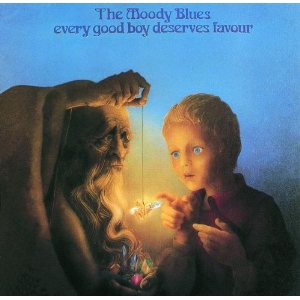 ‘Every Good Boy Deserves Favor’ was the title of a 1971 Moody Blues album. The cover shows a young child and a wizened old man, the child apparently in awe of the old man, perhaps receiving instruction. But why should a good person deserve favor? Didn’t the Moody Blues know about grace? In terms of the human relationship with God His favor is not something that is deserved. It is only possible through grace.
Grace Not Works
But if salvation is possible through grace rather than works, why does Solomon state that a good man obtains favor from the Lord? The answer is simple. Because when salvation occurs Jesus Christ moves in and lives inside us. This may sound weird, but when you think about it we cannot become good, or do good works, unless we are equipped. Having Christ in us provides the enabling for us to obtain the favor of the Lord as we move forwards in obedience to His instruction and guided by His knowledge (Proverbs 12:1).
Another Way
 As always in life we have a choice. There is another way. A way condemned by the Lord. A broad road that leads to destruction, but which is favored by many because of its apparent pleasures. Take a look around. Are you standing in Broad Street? If you are then perhaps it is time to move on. Time to search for the grace that brings eternal favor, rather than temporary pleasure. You have a choice. You always have a choice.
For it is by grace you have been saved, through faith—and this is not from yourselves, it is the gift of God – not by works, so that no one can boast. For we are God’s handiwork, created in Christ Jesus to do good works, which God prepared in advance for us to do. Ephesians 2:8-10 (NIV)
“Enter through the narrow gate. For wide is the gate and broad is the road that leads to destruction, and many enter through it. But small is the gate and narrow the road that leads to life, and only a few find it. Matthew 7:13-14 (NIV)


 Caitlin Klem
 Chris Jordan
 Daniel M. Klem
 dawnlizjones
 David
David Grady Davidson
 Jason Sneed
 M. Wiley Wilson
 Nick
Nick Anthony Baker
 Katie Marie
 Wally Fry

 Proverbial Thought
Zee Doctor Vill See You
Proverbs 12:20
The Evil Psychiatrist
Try to imaging an evil psychiatrist. Can you? Picture in your mind a tall, slick-haired, skinny man in a long, white lab coat. In one eye is a spectacle, the other a creepy glare.
Now, just imagine this guy asking you to come into his office. He offers you a quasi-comfortable couch on which to recline, then pulls out a yellow pad and pencil to take notes – notes of your deepest, darkest secrets.
When your hour is up, you have talked about your parents, your dead dog, a lost love interest, and your lack of self worth. What do you get in return? The Doctor says,
The Caring Counselor
Now, think of someone who wants nothing in return for simple, good advice. This person is caring, can see the end of the road you’re traveling, and wants what is best for you.
You go to this person, pour out your soul, problems and all, and in return you get both sympathy and solid guidance. You are not made to feel like an idiot, but your own words are used to point towards better choices to be made. Hopefully, you can see the difference between the two, yes? No? Vhat iz vrong vid you?
“Imagine Evil” vs “Joy”
One point of today’s proverb is that there are some who would offer counsel for their own selfish desires, while there are others who do it for the joy of bringing about peace. The operative word in the verse is “counselors.”
As a pastor, I have to counsel people all the time. Unlike a psychiatrist, however, I don’t get paid lots of money for my advice.
Now, don’t get me wrong, there is a place for the advice of both, but if the intent of either is selfish, then the advice is evil – free or not.
What Goes Around…
But there is even more to this verse. The idea is that the reason for the advice one gives will ultimately come back upon him. The great Matthew Henry wrote:
If you want to experience joy, then give “peaceful” counsel. If you want to be fooled, then seek to fool others.
*Matthew Henry, Matthew Henry’s Commentary on the Whole Bible: Complete and Unabridged in One Volume (Peabody: Hendrickson, 1994), Pr 12:20.
Leave a comment | tags: Bible, Commentaries, counselling, Matthew Henry, Matthew Henry's Commentary on the Whole Bible, Religion & Spirituality | posted in advice, counsel, Paths of Life, Peace, Reward, The Wicked