Tag Archives: proverbs

Tickets, please.

airplane-2619434_1920I love to fly.  I’ve been in jets, small private planes, and even a free-float hot air balloon.  Something birds take for granted, I suppose, but for me, being up in the air is exhilarating. 

I’m not a pilot, however, so I reap the benefit of their knowledge and expertise.  My oldest brother is a pilot and has a couple of small aircraft up in Minnesota.  One year when visiting up there, he took me up for a look-see around the area with all those beautiful lakes and lush countryside.  We took off and landed on a dirt runway, and he even let me take control to actually “fly” the plane. 

That lasted about ten seconds while I freaked out.

He also told me not to worry, but since my door was partially open, and would I please full it shut and latch it?  Sure, no problem.

I still love flying. Continue reading


Interpreting a Proverb

I am going to do something a little different – I’m going to ask you to do some investigative work.

Please read the following verse from the King James Version of the Bible, then think about what it means.

Don’t look at another translation just yet. Don’t do anything other than read the following verse:

A gift is as a precious stone in the eyes of him that hath it: whithersoever it turneth, it prospereth. – Proverbs 17:8 KJV

What is it talking about?

Is the meaning obvious to you? What first impression do you get when reading it?

Quickly! Leave a comment below as to your first thoughts, then go do your research and leave a second comment.

Don’t cheat! The eyes of the Lord are watching 😉


Have a plan

moses-2628535_1920Moses, what a guy.  Talk about job stress—the perks were pretty great but so were the occupational hazards.  (And I think I have tough days!)  At least there was clear communication with the Boss; no lost email trails or intra-office misinterpretation of body language, all that.  God’s instructions were always unmistakably clear, right down to what colors of decorative embroidery thread to use for the big church tent!

One year into their miraculous escape/rescue from centuries of Egyptian slavery, God now has them positioned to pull up the stakes and start their journey in earnest to the Promised Land. 

He has also promised to be their Guide, a cloud by day and something that looks like a pillar of fire by night.  Again, fairly distinctive, even for someone directionally challenged, like me.  When He moves left, they move left.  When He stops, they stop, and up go all the tents.  Kind of like a cosmic GPS.  What could be easier?

Then I read this short conversation sandwiched in the account of the Israelites getting ready to leave.  It’s between Moses and his brother-in-law, Hobab, (who is not an Israelite).  Moses is inviting him to join them on their journey, and that they will share all the blessings that God will give them. 

“But Hobab replied, ‘No, I will not go. I must return to my own land and family.’  ‘Please don’t leave us,’ Moses pleaded. ‘You know the places in the wilderness where we should camp. Come, be our guide.’”

Hold on.  I thought God was their guide…?  Has the great leader of the Old Testament who walked his people through the sea on dry land and spoken to God Almighty in the burning bush suddenly gotten cold feet?

As much as I love the “humanness” of our biblical heroes, I don’t think that is the case.  We’re talking about over a million human beings here, so “camping out” isn’t just a matter of taking over, say, an entire State Park.  It’s more like taking over Chicago.  God was going to guide Moses to a general area; a good leader was needing to prepare for at least some of the particulars.

Now, I’ll admit that one of my failsafe, fall back phrases is “God’s got a plan”.  Okay, true enough.  But many times, the very real question of the moment is,… do I?

“We can make our plans, but the Lord determines our steps.”

In other words, God’s guidance does not preclude my personal responsibility.  Reasoning brain and redeemed spirit work hand-in-hand.  It may seem like push and shove sometimes, but God can still get His end result accomplished.

ThreadBecause sometimes He may just give us the pattern and let us pick out the color of thread.

Numbers 10:30; Proverbs 16:9 Holy Bible, New Living Translation, copyright © 1996, 2004, 2015 by Tyndale House Foundation. Used by permission of Tyndale House Publishers Inc., Carol Stream, Illinois 60188. All rights reserved.


What’s on your summer reading list?

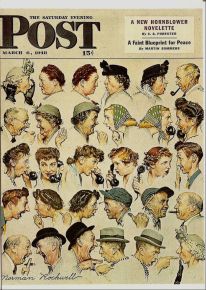
gossip

Another insightful painting by beloved Norman Rockwell.

Bob and I were watching a really interesting TV show on the top 100 popular books.  Now, how they came up with that short list, I don’t know, and it ranged from John Bunyan’s Pilgrim Progress to modern day novels that have influenced people in, well, other ways.

One of the neat things about this program is that it’s interactive, meaning you go online and cast your vote for your favorite book (among the short list, naturally), and you can vote once a day until the show’s finale.  Which means you can stuff the ballot box, I suppose. 

During the show, different people were interviewed on their Number One choice, and I was impressed how this divergent sampling of human effort has influenced individuals, and in some cases, greatly.

Like me.  One of John Bunyan’s other books, Grace Abounding to the Chief of Sinners, was my door to deliverance in a very real way.  But that’s another story, and anyway, I doubt that’s on the list.

The point is that words, or communication of any sort, are powerful.  That includes not only what we put out but just as importantly, what we take in.  In Proverbs chapter 15, information transfer of some sort is mentioned at least fourteen times!  And they didn’t even have social media yet!  Here’s an example of output:

“The tongue of the wise makes knowledge appealing,
    but the mouth of a fool belches out foolishness.”

Most of us have probably been party to both—my hand is raised.  What we perhaps don’t emphasize enough is the personal responsibility of intake:

“Plans go wrong for lack of advice;
    many advisers bring success.”

What I choose to listen to (or read) is actually just as important as what I choose to say (or write, as it were.) We all know the damage done by slurs on social media.  But do we realize that the damage is done not only because those things are put out there, but because they are read? In other words, the reader is just as culpable as the writer.  Always.

I know that I can be quite impacted by stories, mental images both from descriptive writing and the silver screen.  It’s the way we are wired, since the word (lower case “w”) is powerful, being created so by God Himself.  Therefore, what I choose to listen to is also powerful decision.

Sometimes earplugs are a good investment. 

president-1822449_1920

Proverbs 15: 2,22 Holy Bible, New Living Translation, copyright © 1996, 2004, 2015 by Tyndale House Foundation. Used by permission of Tyndale House Publishers, Inc., Carol Stream, Illinois 60188. All rights reserved.


Teenage bedroom–hard hat required.

kids-2030268_1920When our youngest went to Peru on a month-long mission trip right before high school, I decided I would take advantage of her absence to clean her room.  Thoroughly.  As in a full-scale geological excavation. 

I found a full laundry basket, only it was stratified with layers of clean, dirty, clean, etc. I unearthed underwear from elementary school, and (if I recall rightly) a hard, green mass under the bed reputed to be petrified Jello—lime, I think.  Continue reading


Cruisin’

car-309544_1280Our old(est) suburban was purchased in 1994, which seems like a long time ago until you consider this particular vehicle was a 1977.  Yep, complete with the two-tone orange/beige paint job—it was known as “the rolling pumpkin” at the mechanic shop.  No computer, no electric windows, and someone even had enough sense of humor to install glass packs.  Man, you could hear me coming down a hill from a mile away!  It idled so loudly that one morning the sonic waves set of the alarm on the fancy car next to it in the high school parking lot. Continue reading


It Takes Diligent Work to Thrive

This is the real world, and I’m going to share a little slice of mine with you.

Right now, as I am writing this, I have a list of business names and phone numbers to call. The purpose of this is to make sure the business is still in existence and to make sure of the current address and name of the owner.  The business that I am now doing requires that I “qualify” businesses before I try to contact them to discuss employee benefits.

In case you didn’t know, I now work with a great company named Aflac. You may know them by the duck.

But, so you don’t get the wrong idea, even though I am an agent with a Fortune 500 company, I’m still an individual business owner – I have to do all the work to survive.

The insurance business is not easy, but it can be very rewarding. The only thing is that one has to always be prospecting for new business, and in my case, I’m always looking for businesses in need of what we offer and are willing to talk about it. Consistent, diligent, measurable and trackable activity is critical to my success.

If I am not diligent in all I do, I can talk about my future in this business all I want, but I’ll have nothing in the end.

The soul of the sluggard desireth, and [hath] nothing: but the soul of the diligent shall be made fat. – Proverbs 13:4

Sometimes, in order to do what we feel is important in life, we have to take risks. I chose to take the risk and return to the world of sales in order to have more flexibility in ministry. I also did it because driving a school bus has become too demoralizing, dangerous, and detrimental to my physical and mental health (I can’t risk another shoulder surgery and then have nothing to show for all the work I’ve done through the years).

In this situation, the wisdom of Proverbs is directly applicable to my life. I must be diligent.


Instructionless Brutes

It might be nearly the end of the week, and one might think we’d already gotten past the first verse of the chapter, but Proverbs 12:1 stood out to me this morning, and I’d like to tell you why.

Whoso loveth instruction loveth knowledge: but he that hateth reproof is brutish. – Proverbs 12:1

There are a lot of people who feel like there is no need for preachers, teachers, instructors, professors, or pastors. I read their comments any time I write something having to do with the ministry and ministry needs.

Often, and usually with poor spelling and grammar, the irate and biblically-illiterate employ arrogant language and out-of-context verses to “prove” their point. Consider a brief excerpt I copied from one particular conversation…the write goes by the name of Paradox7:

I don’t need an operator to call my LORD , and I have been reading the Bible since I was a child , don’t need an interpreter either…

Jesus actually spoke of wolves in sheep’s clothing , referring to religious leaders of his time , the same people who set him up for murder because he asurped their authority .If you have read the Bible , you can’t really disagree with that sentiment… It is a common bibical theme to be wary of authority figures , but of course many do not get the message , even as Jesus predicted ” for wide is the gate that leads to destruction , and there are many who will walk thru it .”

There is more to being instructed than simply reading the Bible. Many people do that, just like the Ethiopian Eunuch who asked Phillip in Acts 8:31, “How can I [understand], except some man should guide me?”

Godly teachers are a gift from God to the Church (Ephesians 4:11). Some people need them more than others.


Bring On the Red Ink

doggie dunceIt’s been years since I have taken a written test, but even as an adult I still get some well-suppressed jitters when the paper is handed back.  (That is, unless it’s all on computer; I’m showing my vintage, I suppose.)

Who doesn’t remember the composition class in high school with the completed assignment coming back marked up in red from the teacher?  And I only made it to trigonometry and “college math” when I was in high school—I begged off from calculus, thank you very much.  My first trig exam came back into my hands with something like an 11 out of 40 or 50. (I still distinctly remember that “11” at the top of the page.)

Thankfully, nursing school didn’t need calculus or trig, but since this was before the days of ubiquitous computerized machinery—or Google—we needed a special form of math that had to do with calculating IV drip rates, converting “household” and “apothecary” measurements into “metric” portions, and the like.  There’s no wiggle room in this kind of math—the patient’s health (and life) depended on it. 

I’m not sure what kind of memories King Solomon was drawing upon when he wrote this…

“To learn, you must love discipline;
    it is stupid to hate correction.”

…but he may have had a time when he also hoped his own personal physician hadn’t tried to cheat, fake or argue his way through medical school. 

To be a student of any kind takes discipline, and discipline takes humility.  It means embracing the (eventually inevitable) fact that I’m not smart enough on my own to get it right the first time.  Maybe not even the second or third.  That someone may actually know more than me.  That knowledge and skill comes only with persistent personal application, and that, in itself, comes with the price of time and sacrifice.

In reality, the dunce hat doesn’t belong to those who make mistakes, but to those who refuse to learn from them, and from others.

Your future “patients” will thank you.

Proverbs 12:1 Holy Bible, New Living Translation, copyright © 1996, 2004, 2015 by Tyndale House Foundation. Used by permission of Tyndale House Publishers, Inc., Carol Stream, Illinois 60188. All rights reserved.

Doggie Dunce photo from StrangeDangers.com, Google Images


My Expectation Will Hold

When a wicked man dieth, his expectation shall perish: and the hope of unjust men perisheth. – Proverbs 11:7 KJV

This is a fascinating verse to contemplate, so please take a moment to think about these words with me.

Other Translations

If you don’t already know, I love the King James Version of the Bible, but I am not a King James Only-ist by any stretch of the imagination. However, there are times when I wish modern translators could have left well enough alone.

For example, below are four different versions of Proverbs 11:7, each from a very popular translation.

NLT – When the wicked die, their hopes die with them, for they rely on their own feeble strength.

NIV – Hopes placed in mortals die with them; all the promise of their power comes to nothing.

ESV – When the wicked dies, his hope will perish, and the expectation of wealth perishes too.

CSB – When the wicked person dies, his expectation comes to nothing, and hope placed in wealth vanishes.

If you will indulge me for a moment, let’s look at the differences.

The NLT (New Living Translation) changes the word translated “expectation” in the KJV to the plural word “hopes.” Then, somehow “feeble strength” gets thrown in.

The NIV (New Internation Version) translators somehow determined that the “expectation,” or “hope,” is actually in the (wicked) mortal who dies.

The ESV (English Standard Version) seems to imply that the “hope” is not necessarily in the wicked, but they continue in the same idea that when the wicked die there is lost investment.

The CSB (Christian Standard Bible) stays closer to the KJV in the first part of the verse in that it does not overtly imply that the “expectation” is in the wicked, but a possession of the wicked. But in the second part of the verse, it sides more with the ESV and assumes that “hope” is money or “wealth.”

Like I said before, I’m not a KJV-only-ist. I have found each of the above versions useful in my study of the Bible. However, one word, in particular, makes me wish they’d kept things unchanged, or at least interpreted differently.

Expectation

The Hebrew word that is translated as “expectation” is a word that literally means “rope.” Consider the following definition from Strongs Concordance:

תִּקְוָה tiqvâh, tik-vaw’; from H6960; (compare H6961) literally a cord (as an attachment); figuratively, expectancy:—expectation(-ted), hope, live, thing that I long for.

The first two times this word is used in the Old Testament is in Joshua 2:18 and 21. This is the story where Rahab the harlot is given the assurance that she and her household will not be harmed, just as long as she hangs a scarlet cord from the window of her home on the wall of Jericho.

The same word translated “cord” in Joshua 2:18 and 21 is translated “expectation” in Proverbs 11:7. Now, this does not necessarily mean that the “expectation” of the wicked is a rope, but it does give me the idea that what the wicked man has is something that he’s depending on to save him.

Granted, I could be wrong in my interpretation of this verse, but it would seem to me that it’s not too much to believe that the wicked man’s “expectation” is the hope and trust he has in something that will hold on to him, guide him, or keep him after death. It could mean that when a wicked man dies all the hopes others have in him will die with him, but considering the context of the surrounding verses (11:6 and 11:8), I think my interpretation holds more water.

My Expectation

Thankfully, my “expectation” is more akin to the scarlet thread that Rahab hung from her window than anything I can come up with on my own. What I’m counting on to pull me through death into eternal life is the “scarlet thread” woven throughout all of Scripture, the precious blood of Jesus Christ.

“My hope is built on nothing less than Jesus’ blood and righteousness…”

When I die, my expectation will hold.
