
Tag Archives: Jesus

Good Friends

Proverbs 18:24

“A man that hath friends must shew himself friendly: and there is a friend that sticketh closer than a brother.” (KJV).

The Importance of Relationships:

Is there anything in life more important than our relationships? Too often we get focused on wrong things – worldly success, getting ahead in the workplace, acquiring more stuff. But the bottom line is that the most important things we have in our life are our relationships. And did you know that those are the only things that we can take to Heaven with us?

One of the challenges though – living in this sin-cursed earth – is making and keeping good friends. It’s not easy! That’s why I’m so thankful for the wisdom of the Bible. God’s Word doesn’t just address pie-in-the-sky, one-day-when-I-die theology, but rather practical wisdom for daily living. Like how to make friends.

In today’s Scripture, Solomon teaches us two simple, basic truths about friendships. The first one almost seems like a no-brainer: If you want friends, you must be friendly! It’s not really rocket science here now is it folks? If you’re walking around being mean, rude and miserable all day, don’t be surprised if you don’t have many friends! Start being friendly – being loving, peaceful, kind and good, and see how many friends you can make.

The second truth Solomon shares with us is that there is a friend who sticks closer than a brother. Now I believe that ultimately, that verse is speaking of Jesus. He is a friend who sticks closer than a brother – He will never leave us nor forsake us, and nothing can separate us from His love. And as Christians, we are called to follow His example and be a faithful, loyal friend.

I want to close with a simple story that has challenged me to go out of my way to look for ways to help those around me – one of our highest callings as the children of God!

A Simple Gesture:

Mark was walking home from school one day when he noticed that the boy ahead of him had tripped and dropped all the books he was carrying, along with two sweaters, a baseball bat and a glove. Mark knelt down and helped the boy pick up the scattered articles. Since they were going the same way, he helped to carry part of the burden. As they walked, Mark discovered the boy’s name was Bill, that he loved video games, baseball and history; that he was having a lot of trouble with his other subjects and that he had just broken up with his girlfriend.

Mark went home after dropping Bill at his house. They continued to see each other around school, had lunch together once or twice, then both graduated from junior high school. They ended up in the same high school, where they had brief contacts over the years. Finally the long-awaited senior year came. Three weeks before graduation, Bill asked Mark if they could talk.

Bill reminded him of the day years ago when they had first met. “Do you ever wonder why I was carrying so many things home that day?” asked Bill. “You see, I cleaned out my locker because I didn’t want to leave a mess for anyone else. I had stored away some of my mother’s sleeping pills and I was going home to commit suicide. But after we spent some time together talking and laughing, I realized that if I had killed myself, I would have missed that time and so many others that might follow. So you see, Mark, when you picked up my books that day, you did a lot more. You saved my life.” Your simple gesture – could save someone’s life! (Story from Chicken Soup for the Soul).

Non-Verbal Communication

Proverbs 16:15

“In the light of the king’s countenance is life; and his favour is as a cloud of the latter rain.”

NON-VERBAL COMMUNICATION

Depending on which study you go on, somewhere between 60 and 93% of all communication is said to be “non-verbal.”  Along with the actual words heard, the listener is also processing the speaker’s inflection, facial expressions, gestures, posture, and a host of other context clues.  Most of the time, we process this non-verbal communication instinctively to arrive at the speaker’s total meaning.  Communication is complex, but God has gifted man’s intellect to sort through it all in the beautiful art of human conversation.

Today’s proverb is about non-verbal communication between the king and one of his subjects.  Perhaps the subject has been arrested and charged with a crime of a serious nature.  For whatever reason, the poor man is hauled in before the king.  As the charges are read, the subject dares not lift his eyes from the parquet marble floor of the throne room.   But then the defendant’s legal counsel urges him to look up at the king!  Trembling, he lifts his chin, and against all hope, he see the light of acquittal in the king’s eyes!  Overwhelmed with grateful joy, the king’s subject falls to the floor. With tears streaming, he thanks his king for granting him life.

STANDING BEFORE KING JESUS

Dear reader, one day soon you will face King Jesus.  It may be this very day, or it may be years hence. But God’s Word testifies that God the Father has granted to His Son the authority to judge the world with justice.  That this unique honor is given to Jesus is proven by God’s raising Jesus Christ from the dead (Acts 17:31).  What do you expect to see in the eyes of Jesus on that awesome day?  The light of life? Or will his face be full of wrath and the verdict of death (Proverbs 16:14)?

The gospel tells us that in His great love, God did the most amazing thing:  He sent His Son, the King, to earth to receive God’s wrath against the sin of man.  God has a measured, just, hatred of sin.  Sin cannot be ignored.  That’s why King Jesus went to the Cross!  To be the sin-bearer!

Now the gospel commands all men, women, boys and girls, from every nation, tribe, language and people group to repent of their sins and to receive Jesus Christ as Lord and Savior (Acts 2:38, 17:30).  The result?  That you will one day look into the eyes of your Judge, and there you see the loving eyes of your Savior—even the Lord Jesus Christ.

Father God:  In the countenance of your own dear Son, we see the light of life.  May his face shine in all of its glorious, merciful brilliance upon the reader this day.  Through Christ our Lord we pray: Amen. 


What Makes a King a King?

Proverbs 16:12

“It is an abomination to kings to commit wickedness: for the throne is established by righteousness.”

A king detests wrongdoing, for his rule is built on justice. (NLT)

I have never met an earthly king, but I have often wondered what makes a king a king, or a queen a queen. The history books tell us that many kings and queens built their rule not on justice and righteousness, but on evil and by instilling fear among their subjects. There are countries in our world that continue to be ruled in this way.

Jesus was born into poverty in a land ruled by terror. A foreign king ruled the land with the help of a local puppet king. Neither covered themselves in glory in the way that they ruled. Compare Caesar and Herod to Jesus. The fact that Jesus was different was evident after His arrest when He was interrogated by Pilate, the Roman governor for the province:

Pilate then went back inside the palace, summoned Jesus and asked him, “Are you the king of the Jews?”
“Is that your own idea,” Jesus asked, “or did others talk to you about me?”
“Am I a Jew?” Pilate replied. “Your own people and chief priests handed you over to me. What is it you have done?”
Jesus said, “My kingdom is not of this world. If it were, my servants would fight to prevent my arrest by the Jewish leaders. But now my kingdom is from another place.”
“You are a king, then!” said Pilate.
Jesus answered, “You say that I am a king. In fact, the reason I was born and came into the world is to testify to the truth. Everyone on the side of truth listens to me.” (John 18:33-38 NIV)

Did Pilate understand what Jesus was saying? Here was a King like no other. A King who is holy and perfect in every way that we are not. A King from another place who cannot be compared to any earthly ruler, but a King who considers every human welcome in His Kingdom. It is not us that this King judges, but our wrongdoing. His rule is built on justice, and the forgiveness made possible by His sacrifice.

Before Jesus all human beings are equal, and all are equally welcome. He hates the wrongdoing, but He loves the wrongdoer. What a King!


Who’s the Boss?

Proverbs 16:3

“Commit thy works unto the LORD, and thy thoughts shall be established.” (KJV). 

The Secret to Success:

What is the secret to success? The world tells us that we just need to “be positive, focus, be persistent and work hard!” Is that all it takes? Or is there something else that we can do if we want to do well in life? Eugene Peterson paraphrases today’s Scripture with these words: “Put God in charge of your work, then what you’ve planned will take place.” (The Message).

Here are two important keys from the Scriptures that will help your plans to come to pass:

  1. Delight Yourself in the Lord:

Psalm 37:4 says, “Delight yourself also in the LORD; and he shall give you the desires of your heart.” If we want our thoughts to be established, and see our goals accomplished, the first thing we should do is spend time with God, and ask Him what His plans for our lives are. Too many Christians come up with their own ideas and plans and go to God and say, “Lord, will you bless my plans?” But those plans are not always His will for our lives, and so He may not bless them.

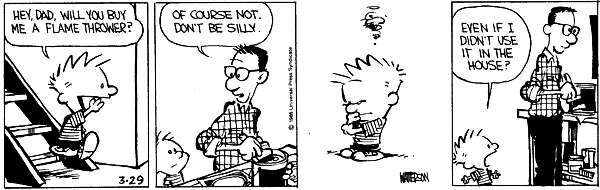
One of my favourite comic strips characters Calvin, from Calvin and Hobbes went to his dad and said, “Will you buy me a flame thrower?” His response was, “No.” Does that mean that his dad didn’t love him? Of course not! But he knew his son well enough to know that if he gave into his request, it would have disastrous consequences. So, if we want to see our thoughts established, we must first spend time with the Lord and ask Him what He wants us to do.

This is one of the reasons why the ministry of Jesus was so successful. He only did what the Father told Him to do! Jesus said, “The Son can do nothing of Himself, but what He sees the Father do.” (John 5:19). I was in ministry for several years before I learned this important principle: Instead of going to God with my plans and saying, “Would you bless them?” I now go to God and say, “What’s your plan for today, Father?”

  1. Walk in Obedience:

If we want God to see our plans succeed, we need to walk in obedience to the Lord. The first part of that is obedience to the general will of God as recorded in the Scriptures. James 1:25 says, “But he who looks into the perfect law of liberty and continues in it, and is not a forgetful hearer but a doer of the work, this one will be blessed in what he does.” The second part is obedience to the specific will of God for our lives, which is revealed to us in prayer. God has blessed us to be a blessing – who does He want you to bless today?

What is God calling you to do? Do it and it will be blessed!

Calvin & Hobbes - flame thrower

(Calvin & Hobbes (c) 2013 Bill Waterson).


Purposes Established!

Proverbs 15:22

“Without counsel purposes are disappointed: but in the multitude of counsellors they are established.” (KJV). 

I love the Bible, and especially the book of Proverbs! There is so much practical wisdom for daily living in God’s Word. Someone described the Bible once using this acrostic: B.I.B.L.E. = Basic Instructions Before Leaving Earth. If the God who created the universe wrote a book, a detailed instruction manual for living life, then we would be wise to heed its advice.

In the above Scripture, Solomon tells us that there are many people who purpose or plan to do things but they are disappointed because of a lack of counsel. However, he says that there is wisdom in the multitude of counsellors. In other words, if you are trying to do something, don’t be so prideful that you try to do it yourself – get help! Seek wisdom and advice from others.

Towards the end of 2009, I had a dream to write a book. However, I had never written a book before. Sure, I had transcribed sermons and put together short little booklets and devotionals for our church family, but I had never written or published a full length book before. So, the first thing I did was I started talking to people. I got advice from writing buddies – from Wendy Neudorf, who is also a writer and blogger, who helped me edit my manuscript, to Nichole Forbes, my wife’s cousin who is also a writer and blogger. From their advice and that of many others – including words of wisdom I found in books and online blogs on writing – I began the task of writing a book.

In June of 2010, I published my first book – Supernatural: Contending for Signs and Wonders Today. I don’t believe my dream would have ever been fulfilled, nor would it have been as good as it was, without the advice and feedback from many wise and good friends.

As I pastor, I seek God’s wisdom and guidance on a regular basis concerning the mission and vision of our church family. I am so thankful for a great team of leaders that speak into my life and help me to make wise decisions concerning God’s church. I have our elders who pray together with me to discern God’s direction, and a church council who help me make decisions concerning our church finances and building use. It’s so true that there is wisdom in a multitude of counsellors! On our own, we have blind spots, weaknesses, and lack knowledge and experiences, and can greatly benefit from the wisdom and input of others.

The New Living Translation of the above Scripture says: “Plans go wrong for lack of advice; many counselors bring success.” Do you have a dream for your life, a goal or a plan that you want to accomplish? Talk to people about it. Get wisdom and counsel from people, from books, and of course ultimately from the Bible. Do this and you will see your purposes established!


Sacri-nice

Proverbs 15:8

“The Lord detests the sacrifice of the wicked,
    but the prayer of the upright pleases him.”

What God Wants…

God hates the sacrifice of the wicked, but he isn’t to keen on the sacrifice of the righteous either, especially when it becomes the be all and end all. Countless times in the Bible God makes the point that He isn’t interested in sacrifices, the idea of coming and making a payment for your transgressions. No, what He is interested in is your behavior, how you will respond to His grace and forgiveness in your own life, and how that will inspire you to treat others.

Inspired by?

In Matthew 18 we see the story of a servant who owes his master a huge amount of money. He’s panicking, how will he pay this back? What will happen to his family? He goes before the master and begs for more time, and incredibly the master let’s him off. Scot free. Let’s not miss the huge significance of this – this is truly incredible and as counter cultural now as it was then.

I sometimes watch Undercover Boss, now I am not naive I know it’s probably scripted, but I can’t help but be moved when some big CEO enters the life of a low level employee, sees their struggles and their debt, and does something about it. What we never see is how this affects the person in question. They seem very grateful in the moment, but we never see the lasting change.

Not so with this servant. The Bible tells us that straight away he went looking for another servant who owed him a considerably smaller amount. We’d be entitled to think that he had in mind to set this servant free from his debt, to share the grace he had experienced. But in fact all he wants is the money owed to him. How sad that this servant was even more enslaved to money than he originally thought.

Washing feet

At the opposite end of the spectrum we find Jesus. Jesus the entirety of God squeezed into man form, denying His deity to inspire humanity, relying fully on the Father to further the future of the broken. We all know Jesus washed His disciples’ feet, we all know this should blow our tiny minds, but I’ll be honest it was just one of those things I accepted, until I reread the account and came to these verses in John 13:3-5 ‘Jesus knew that the Father had put all things under his power, and that he had come from God and was returning to God; so he got up from the meal, took off his outer clothing, and wrapped a towel around his waist. After that, he poured water into a basin and began to wash his disciples’ feet, drying them with the towel that was wrapped around him.’ 

Why did Jesus do this? BECAUSE He knew who he was. Because He wanted to show the world a powerful image of what happens when we take the lowest place.

Prayer

All very good and well you may say but how’s this connected to the proverb? Prayer changes everything. If you want to be a person who shares grace rather than shrugs grace then you need to start on your knees.


Control Your Anger

Proverbs 14:29

“He that is slow to wrath is of great understanding: but he that is hasty of spirit exalteth folly.” (KJV).
“Those who control their anger have great understanding; those with a hasty temper will make mistakes.” (NLT).

The Emotion of Anger

The Book of Proverbs gives us a smorgasbord of wisdom that applies to every area of our life: It gives us wisdom in our relationships, family life, dealing with finances and walking in righteousness. But it also gives us a window into our heart, and helps us to consider our emotions as well. In the above Proverb, Solomon addresses the emotion of anger.

Anger is not necessarily a bad thing. It is an emotion, and when we are treated unfairly, we are going to get angry. However, what we do with that emotion is what makes it good or evil. If we can control our anger, it proves that we have great understanding. But those with a hasty temper will make mistakes. I’ve seen people get angry and then do things that they later regretted, impulsive and often embarrassing mistakes. When we control our anger, we can avoid some of those blunders.

How do we control our anger?

So what is the antidote to a person who struggles with anger? It’s easy to say, “Stop being so angry!” But it’s another thing entirely to try to control those emotions in your own life. What is the answer then? I believe it’s found in a letter that the Apostle Paul wrote to a church in Galatia. He starts out by identifying the problem: “When you follow the desires of your sinful nature, your lives will produce these evil results: sexual immorality, impure thoughts, eagerness for lustful pleasure, idolatry, participation in demonic activities, hostility, quarreling, jealousy, outbursts of anger, selfish ambition, divisions, the feeling that everyone is wrong except those in your own little group, envy, drunkenness, wild parties, and other kinds of sin. Let me tell you again, as I have before, that anyone living that sort of life will not inherit the Kingdom of God.” (Gal. 5:19-21). He then gives the solution: “But when the Holy Spirit controls our lives, he will produce this kind of fruit in us: love, joy, peace, patience, kindness, goodness, faithfulness, gentleness, and self-control.” (Gal. 5:22-23).

How do we get more of this fruit of the Spirit in our lives? Spend time with Jesus in prayer! Jesus said, “Abide in Me, and I in you. As the branch cannot bear fruit of itself, unless it abides in the vine, neither can you, unless you abide in Me. I am the vine, you are the branches. He who abides in Me, and I in him, bears much fruit; for without Me you can do nothing” (John 15:4-5).

Lord, help us to abide in the secret place of prayer, abiding in Jesus the Vine, so we can bear the fruit of the Spirit in our lives. Amen!


The Evil Dead

Proverbs 14:19

‘Evil men will bow down in the presence of the good,
    and the wicked at the gates of the righteous.’

Slim Consolation

The Bible is full of good honest people asking the question, “Why do bad people prosper, and good people suffer?” This is a question that still haunts us now. The song writer Josh Garrels quips in his song ‘Farther Along’ – ‘Tempted and tried, I wonder why the good man dies, bad man thrives and Jesus cries cus He loves them both.’ The Bible also tells us that the bad, or evil will get their comeuppance. But when we are seeing the evil thrive very close to home while we also struggle to live the way we’d like, not to mention all our brothers and sisters all over the world facing persecution for Christ, this can be hard to swallow. This verse may provide some comfort in the thought that one day things will be made right, but what about now?

The Inconvenient Truth

Romans 11 verse 14 tells us that one day every knee will bow and every tongue confess that Jesus is Lord, whether they want to or not! One day you may be falling to your knees in worship while the person next to you is having an uncomfortable moment of realisation and regret. What will you think in that moment? Will you be glad that the evil are finally about to get their just desserts? Or will you be wishing you had done more to help people see Jesus in this life so they are not surprised in the next?


Just Reward

Proverbs 14:14.

“The backslider in heart shall be filled with his own ways: and a good man shall be satisfied from himself.”

Christian Karma?

There are many religions in the world who believe in karma. Hindus, Buddhists and Sikhs for example all believe in the concept of “action” or “deed”, that which causes the entire cycle of cause and effect. In other words, if you are a good person, good things will happen to you, and if you are a bad person, bad things will happen to you. You might be surprised to learn that this idea actually has its origins in the Bible. King Solomon wrote: “Backsliders get what they deserve; good people receive their reward.” (Prov. 14:14, NLT).

Now lest some of you begin calling me a heretic for suggesting that karma is a Christian concept, let me clarify. Karma is a twisted and imperfect understanding of the Scriptural principle of reaping and sowing which the Apostle Paul describes here: “Don’t be misled. Remember that you can’t ignore God and get away with it. You will always reap what you sow! Those who live only to satisfy their own sinful desires will harvest the consequences of decay and death. But those who live to please the Spirit will harvest everlasting life from the Spirit.” (Galatians 6:7-8, NLT).

Consequences for our Actions:

Today’s Proverb teaches us that there are consequences for our actions. If you are a backslider, you will get what you deserve. If you live a life of sin and rebellion against God and His Word, don’t be surprised when life doesn’t work for you! But if you are a good person, and live to please the Spirit, you will receive a blessing from the Lord.

Let me illustrate. My dad was an alcoholic womanizer. He slept with many women in his life, and as a consequence, I have two sisters, two half-sisters, and at least three half-brothers that I know about (maybe more). My dad died about five years ago from a cancer that was caused from his excessive drinking and cigarette smoking. Sadly, this is an example of reaping what you sow.

Sometimes we live a sinful life and then experience the consequences for that sin, and we get mad at God and say, “How could you let this happen to me?” But it wasn’t God punishing us for our wrong decisions, but rather leaving us to the just reward of our own choices.

A Harvest of Blessing:

The good news today is that God is a merciful, gracious God. All of us have sinned, rebelled, and disobeyed His commandments, but we can confess our sins to Him and receive His free forgiveness. In Paul’s letter to the Galatians, he added an action plan for all of us. In light of the fact that there are consequences for our choices, he says, “So don’t get tired of doing what is good. Don’t get discouraged and give up, for we will reap a harvest of blessing at the appropriate time.” (6:9, NLT).


Bittersweet Testimony

Proverbs 14:10

“Each heart knows its own bitterness,
    and no one else can share its joy.”

Know Thy Self

The only person who knows your heart better than God is you. You know how it feels to be you. You know what what it feels like to hurt like you hurt. You and God are the only ones who know the depth of the bitterness contained in your own heart. Other people might have been through similar things, they might have some level of understanding but the only other person to know the full picture is God.

All by Myself

So is this proverb suggesting we should shut up shop, keeping our bitterness and joy to ourselves? I would like to suggest not. This proverb isn’t saying no one should share it’s joy, it is just making the observation that the natural state of play is that no one knows what is truly going on in someone’s heart (except God) unless we learn to share our hearts with others.

Grieving and Rejoicing Together

Romans 12:15 tells us to “Rejoice with those who rejoice; mourn with those who mourn.” This is only possible if we open our hearts to others. Now I am not saying we should share our intimate secrets with all and sundry but it is healthy to have a few trusted confidants to open our hearts to.

Extended Family

When we first found out that I had a low sperm count we had to decide whether to keep this news to ourselves or share it with our church family. When I got up and told our church I said something like this: “I tell you this now not for your pity, but so that as you grieve with us presently you will rejoice with us when we have our children.”