Tag Archives: proverbs

Non-Verbal Communication

Proverbs 16:15

“In the light of the king’s countenance is life; and his favour is as a cloud of the latter rain.”

NON-VERBAL COMMUNICATION

Depending on which study you go on, somewhere between 60 and 93% of all communication is said to be “non-verbal.”  Along with the actual words heard, the listener is also processing the speaker’s inflection, facial expressions, gestures, posture, and a host of other context clues.  Most of the time, we process this non-verbal communication instinctively to arrive at the speaker’s total meaning.  Communication is complex, but God has gifted man’s intellect to sort through it all in the beautiful art of human conversation.

Today’s proverb is about non-verbal communication between the king and one of his subjects.  Perhaps the subject has been arrested and charged with a crime of a serious nature.  For whatever reason, the poor man is hauled in before the king.  As the charges are read, the subject dares not lift his eyes from the parquet marble floor of the throne room.   But then the defendant’s legal counsel urges him to look up at the king!  Trembling, he lifts his chin, and against all hope, he see the light of acquittal in the king’s eyes!  Overwhelmed with grateful joy, the king’s subject falls to the floor. With tears streaming, he thanks his king for granting him life.

STANDING BEFORE KING JESUS

Dear reader, one day soon you will face King Jesus.  It may be this very day, or it may be years hence. But God’s Word testifies that God the Father has granted to His Son the authority to judge the world with justice.  That this unique honor is given to Jesus is proven by God’s raising Jesus Christ from the dead (Acts 17:31).  What do you expect to see in the eyes of Jesus on that awesome day?  The light of life? Or will his face be full of wrath and the verdict of death (Proverbs 16:14)?

The gospel tells us that in His great love, God did the most amazing thing:  He sent His Son, the King, to earth to receive God’s wrath against the sin of man.  God has a measured, just, hatred of sin.  Sin cannot be ignored.  That’s why King Jesus went to the Cross!  To be the sin-bearer!

Now the gospel commands all men, women, boys and girls, from every nation, tribe, language and people group to repent of their sins and to receive Jesus Christ as Lord and Savior (Acts 2:38, 17:30).  The result?  That you will one day look into the eyes of your Judge, and there you see the loving eyes of your Savior—even the Lord Jesus Christ.

Father God:  In the countenance of your own dear Son, we see the light of life.  May his face shine in all of its glorious, merciful brilliance upon the reader this day.  Through Christ our Lord we pray: Amen. 


What Makes a King a King?

Proverbs 16:12

“It is an abomination to kings to commit wickedness: for the throne is established by righteousness.”

A king detests wrongdoing, for his rule is built on justice. (NLT)

I have never met an earthly king, but I have often wondered what makes a king a king, or a queen a queen. The history books tell us that many kings and queens built their rule not on justice and righteousness, but on evil and by instilling fear among their subjects. There are countries in our world that continue to be ruled in this way.

Jesus was born into poverty in a land ruled by terror. A foreign king ruled the land with the help of a local puppet king. Neither covered themselves in glory in the way that they ruled. Compare Caesar and Herod to Jesus. The fact that Jesus was different was evident after His arrest when He was interrogated by Pilate, the Roman governor for the province:

Pilate then went back inside the palace, summoned Jesus and asked him, “Are you the king of the Jews?”
“Is that your own idea,” Jesus asked, “or did others talk to you about me?”
“Am I a Jew?” Pilate replied. “Your own people and chief priests handed you over to me. What is it you have done?”
Jesus said, “My kingdom is not of this world. If it were, my servants would fight to prevent my arrest by the Jewish leaders. But now my kingdom is from another place.”
“You are a king, then!” said Pilate.
Jesus answered, “You say that I am a king. In fact, the reason I was born and came into the world is to testify to the truth. Everyone on the side of truth listens to me.” (John 18:33-38 NIV)

Did Pilate understand what Jesus was saying? Here was a King like no other. A King who is holy and perfect in every way that we are not. A King from another place who cannot be compared to any earthly ruler, but a King who considers every human welcome in His Kingdom. It is not us that this King judges, but our wrongdoing. His rule is built on justice, and the forgiveness made possible by His sacrifice.

Before Jesus all human beings are equal, and all are equally welcome. He hates the wrongdoing, but He loves the wrongdoer. What a King!


Mercy and Fear

Proverbs 16:6

“By mercy and truth iniquity is purged: and by the fear of the LORD men depart from evil.”
“In mercy and truth Atonement is provided for iniquity; And by the fear of the LORD one departs from evil.” (NKJV)

“He Could Break Me”

When I was young I had a healthy fear of my father. Even when I was a teenager, he was half again my size and could break me in two. The last thing I would have ever wanted was for my dad to strike me in anger, or worse, as an enemy. Thankfully, he loved me, especially when he “spared not the rod.”

Yes, my dad knew how to discipline in the old-fashioned way. He did not believe in “time outs.” Never once did he remind me to “make right choices.” If I made a wrong choice I found out about it real quick.

daddyBut the thing that I was most afraid of was not being punished by my dad for doing something stupid, it was breaking his heart. The worst punishment I could ever receive was to see a disappointed look in his eyes. I wanted him to be proud of me. I was more afraid of seeing a tear than getting whacked in the rear.

You see, my dad was a godly man…a simple man…a humble man…a very hard-working man. He worked multiple jobs, once even giving me his pay so that I could have work. He never raised his voice, but he could preach with authority. He was a true pastor, a faithful husband, and a friend to all. He did a lot for me that I will never know.

Proper Motivation

In today’s proverb Solomon speaks of mercy and forgiveness, but then he ends with “fear” being the motivation for correct behavior. What should be noted is that “fear” isn’t the kind of emotion that causes one to run and hide, but it is a profound sense of respect.

When we think of God, we should remember how merciful he has been to us. We should contemplate his goodness and grace. We should remember that He did not have to forgive us, but would have been completely justified to cast us into a burning hell forever, had it not been for Christ. When we remember these things we should fear and “depart from evil.”

But why should we depart from evil? Is it because of a fear that He will destroy us? No, for we are forgiven, if we have been covered in the righteousness of Jesus. We should have a profound respect for what God has done for us, not to us, and that fear should cause us to depart from evil.


Who’s the Boss?

Proverbs 16:3

“Commit thy works unto the LORD, and thy thoughts shall be established.” (KJV). 

The Secret to Success:

What is the secret to success? The world tells us that we just need to “be positive, focus, be persistent and work hard!” Is that all it takes? Or is there something else that we can do if we want to do well in life? Eugene Peterson paraphrases today’s Scripture with these words: “Put God in charge of your work, then what you’ve planned will take place.” (The Message).

Here are two important keys from the Scriptures that will help your plans to come to pass:

  1. Delight Yourself in the Lord:

Psalm 37:4 says, “Delight yourself also in the LORD; and he shall give you the desires of your heart.” If we want our thoughts to be established, and see our goals accomplished, the first thing we should do is spend time with God, and ask Him what His plans for our lives are. Too many Christians come up with their own ideas and plans and go to God and say, “Lord, will you bless my plans?” But those plans are not always His will for our lives, and so He may not bless them.

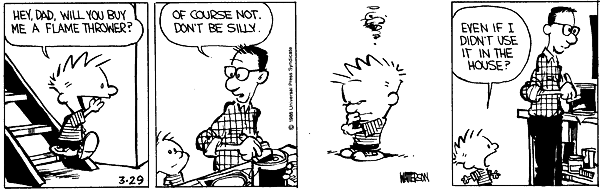
One of my favourite comic strips characters Calvin, from Calvin and Hobbes went to his dad and said, “Will you buy me a flame thrower?” His response was, “No.” Does that mean that his dad didn’t love him? Of course not! But he knew his son well enough to know that if he gave into his request, it would have disastrous consequences. So, if we want to see our thoughts established, we must first spend time with the Lord and ask Him what He wants us to do.

This is one of the reasons why the ministry of Jesus was so successful. He only did what the Father told Him to do! Jesus said, “The Son can do nothing of Himself, but what He sees the Father do.” (John 5:19). I was in ministry for several years before I learned this important principle: Instead of going to God with my plans and saying, “Would you bless them?” I now go to God and say, “What’s your plan for today, Father?”

  1. Walk in Obedience:

If we want God to see our plans succeed, we need to walk in obedience to the Lord. The first part of that is obedience to the general will of God as recorded in the Scriptures. James 1:25 says, “But he who looks into the perfect law of liberty and continues in it, and is not a forgetful hearer but a doer of the work, this one will be blessed in what he does.” The second part is obedience to the specific will of God for our lives, which is revealed to us in prayer. God has blessed us to be a blessing – who does He want you to bless today?

What is God calling you to do? Do it and it will be blessed!

Calvin & Hobbes - flame thrower

(Calvin & Hobbes (c) 2013 Bill Waterson).


Are You Afraid?

Proverbs 15:33

“The fear of the Lord teaches a man wisdom,
    and humility comes before honor.”

What is Fear?

We see lots of mention of fear in the Old Testament. It’s a word that doesn’t fit well with our modern mindset, and so many people who speak about these verses reduce fear to something else. They tell us it is more like awe or respect. Yet even these words have been diluted by our present culture.

When I was a child and did something wrong, I feared the consequences, I feared my parents and the discipline they would bring, the telling off I would receive. Today children seem to fear very few things, and the ideas of respect and awe are replaced by individualism.

Real Fear

But what if fear means fear? What if there is reason to fear God, and this reason makes the grace He shows us all the more amazing?

In the Old Testament the Israelites were afraid to approach the mountain that God met Moses on, Jacob comments on how he came face to face with God and lived.  Maybe fear is the beginning of all wisdom because when we realize that God could do anything He wants at any time, He could make our lives miserable and full of suffering, He could punish us for our sins.

And yet he doesn’t.

Instead He pours grace upon us, and in Jesus shows us how humility comes before honor.


The Cost of Bribes

Proverbs 15:27

“He that is greedy of gain troubleth his own house; but he that hateth gifts shall live.” 

“A greedy man brings trouble to his family, but he who hates bribes will live.” – NIV

Same Script

Have you ever noticed how most crime dramas on television are the same, at least in the writing department? When we read in Ecclesiastes 1:9 that there is “no new thing under the sun,” it especially applies to television and movie plots.

One reason that it is hard to come up with anything new is because men keep doing the same things over and over again. The stories are all so similar in pattern because the template is ingrained in man’s fallen nature. He keeps falling for the same old tricks every time, like fish that never question a swimming worm.

One common story line involves a man who needs money, takes a bribe, gets caught, then brings his family to ruin. It varies, of course, but whether it’s a politician who takes a bribe in order to keep his career afloat, or a discouraged policeman who deals confiscated drugs in order to take care of his sick children, the end is always the same – trouble.

Doing What’s Right

It is not always easy to turn down easy money. Sometimes the offer can seem pretty tempting. Several years ago my wife and I were asked to hire undocumented workers in order to keep down the costs of a cleaning contract. We were told over and over, “They work hard for little money…everyone does it…no one will find out.” We could have saved thousands of dollars in labor costs.

Doing what is right, however, is more important than money. Greed is the downfall of many. What would have happened my wife’s company had been visited by federal agents? How many lies would she have been responsible for when she filed payroll taxes? What would have happened to our family of one of us had been sent to jail?

Even when times are at their worst, doing wrong, taking a bribe, doing it for the money, is never good for one’s home. Somebody down the line will pay for poor choices made.


He Reads Minds

Proverbs 15:26

“The thoughts of the wicked are an abomination to the LORD: but the words of the pure are pleasant words.”

Reading Minds

I am not a mind reader, but I can usually tell you what my children are thinking. When they get angry with each other, they want revenge. When one gets hurt, the other is sad, but only on the outside…they laugh on the inside.

I have even become better at reading my wife’s mind. When she says that she is not feeling well, what she really wants is for me to make dinner, pay the bills, clean the house, and help the children with their homework. When she says, “Honey, let’s put the kids to bed early tonight,” what she really wants is to go to bed early…after watching the news. Pretty simple.

However, when it really comes down to knowing every little thought in a person’s mind, only God can do that (Hebrews 4:13-13). He even knows more than Santa Claus.

Hidden Thoughts

The wicked think they can fool God. They parade around doing good, like feeding the homeless, adopting orphans, or hammering a nail in a habitat. They go to church; have pews named after them; and occupy seats on the most influential boards; yet, inside they are “full of dead men’s bones.” Who are they kidding?

The wicked don’t have to do anything outwardly bad; Yahweh knows their thoughts. He knows their motivations. He can read their minds, even when their actions are an attempt to disguise.

Nothing Hidden

The pure of heart have nothing to hide. Their actions betray their thoughts in a good way. Their words are windows into hearts with proper intentions, and the Lord loves to hear them speak.

God doesn’t even have to hear the wicked speak to know what’s on their minds (Matt. 15:19). He says, “I know what you’re thinking, so don’t even say it.” But the pure, the righteous, are a different story altogether. He says, “Come, let us reason together…I’d love to hear what you have to say.


A Timely Word

Proverbs 15:23

“A man hath joy by the answer of his mouth: and a word spoken in due season, how good is it!”

In yesterday’s Proverbial Thought – “Purposes Established!”, it was discussed just how important it is to seek counsel. Today’s verse we flip to the other side of the coin and talk about when someone come to us seeking advice what is our response. Today’s verse focuses on not only giving the right advice but giving it at the appropriate time. I love the way the HCSB says our verse, “A man takes joy in giving an answer; and a timely word — how good that is!”

The book of Proverbs contains many words of advice and wisdom regarding our speech. It also gives us several reasons for our words:

It’s All About the Timing

As it was says earlier, a wise person not only knows the correct response to give but also gives it at the correct time. This wise counsel was given to us in Ecclesiastes 8:5-6:

“Whoever keeps a command will know no evil thing, and the wise heart will know the proper time and the just way. For there is a time and a way for everything, although man’s trouble lies heavy on him.”

Proverbs 25:11 also tells us:

“A word fitly spoken is like apples of gold in a setting of silver.” 

We have all either heard of stories or experienced them ourselves. The story of someone going through a hard time, having a loved one die or receiving some extremely bad news. And then it happens. Someone who is trying to console them with words tells them of their cousin’s best friend’s mother who went through the exact same thing but tells them of the horrific end that took place.

Why do we (yes, I have done this myself) think this is going to make them feel better? The timing was way off and not at all comforting to the receiver.

This reminds me Job. During the time that he was devastated by the news he had just received, three visitors came to him and basically started telling him it was all his fault. How is that for positive reenforcement!

Solomon is telling us in our verse that the proper words spoken at the proper time will be good news to both the giver of those words and the receiver.

So the next time you are going to give advice to someone, not only remember that there are right words to say but that there is also the right time to say them.


Purposes Established!

Proverbs 15:22

“Without counsel purposes are disappointed: but in the multitude of counsellors they are established.” (KJV). 

I love the Bible, and especially the book of Proverbs! There is so much practical wisdom for daily living in God’s Word. Someone described the Bible once using this acrostic: B.I.B.L.E. = Basic Instructions Before Leaving Earth. If the God who created the universe wrote a book, a detailed instruction manual for living life, then we would be wise to heed its advice.

In the above Scripture, Solomon tells us that there are many people who purpose or plan to do things but they are disappointed because of a lack of counsel. However, he says that there is wisdom in the multitude of counsellors. In other words, if you are trying to do something, don’t be so prideful that you try to do it yourself – get help! Seek wisdom and advice from others.

Towards the end of 2009, I had a dream to write a book. However, I had never written a book before. Sure, I had transcribed sermons and put together short little booklets and devotionals for our church family, but I had never written or published a full length book before. So, the first thing I did was I started talking to people. I got advice from writing buddies – from Wendy Neudorf, who is also a writer and blogger, who helped me edit my manuscript, to Nichole Forbes, my wife’s cousin who is also a writer and blogger. From their advice and that of many others – including words of wisdom I found in books and online blogs on writing – I began the task of writing a book.

In June of 2010, I published my first book – Supernatural: Contending for Signs and Wonders Today. I don’t believe my dream would have ever been fulfilled, nor would it have been as good as it was, without the advice and feedback from many wise and good friends.

As I pastor, I seek God’s wisdom and guidance on a regular basis concerning the mission and vision of our church family. I am so thankful for a great team of leaders that speak into my life and help me to make wise decisions concerning God’s church. I have our elders who pray together with me to discern God’s direction, and a church council who help me make decisions concerning our church finances and building use. It’s so true that there is wisdom in a multitude of counsellors! On our own, we have blind spots, weaknesses, and lack knowledge and experiences, and can greatly benefit from the wisdom and input of others.

The New Living Translation of the above Scripture says: “Plans go wrong for lack of advice; many counselors bring success.” Do you have a dream for your life, a goal or a plan that you want to accomplish? Talk to people about it. Get wisdom and counsel from people, from books, and of course ultimately from the Bible. Do this and you will see your purposes established!


The Hot Head

Proverbs 15:18

“A wrathful man stirreth up strife: but he that is slow to anger appeaseth strife.”

A Hot-Tempered Person

I love how our verse is stated in the ESV – “A hot-tempered man stirs up strife, but he who is slow to anger quiets contention.”

We all know someone who is a hot-head. Someone who is easily provoked or short-fused. They become angry at the drop of a hat. The old saying, “Some people get angry at the drop of a hat and some throw the hat down themselves” is so true of our verse.

Solomon is telling us that those wrathful, hot-headed people are only going to cause more problems and strife.

The Calming Solution

Our verse today is not the first verse we have seen in Proverbs 15 that talks about how to deal with wrathful people. Proverbs 15:1 says, “A soft answer turns away wrath, but a harsh word stirs up anger”.

Solomon is basically telling us that the best way to “keep the peace” is to be calm or slow to anger.

It’s Our Choice

I can sit here and write this post about being calm the next time I am faced with someone who is trying to stir things up or that is angry with me, but when it actually happens, I have two choices: 1. I can become angry at the person and “stir the pot” even more,  or 2. I can stay calm and carefully choose my words. It is up to me!

How will you deal with a hot-tempered person? If you are normally a hot-headed person, how will you respond the next time you have a tendency to “throw down the hat”?