
Tag Archives: proverbs

It’s a Trap!

Proverbs 16:28.

“A froward man soweth strife: and a whisperer separateth chief friends.”

The danger of strife:

In an earlier passage in Proverbs, Solomon describes seven things that the Lord hates (Proverbs 6:16-19). It’s interesting to note that three of those seven have to deal with sins of the mouth – a lying tongue, a false witness who speaks lies, and one who sows discord. As we are working on building healthy relationships, God warns us about one of the deadliest traps to avoid: strife.

Solomon tells us that strife comes from a froward, or a perverse, person. A godly man on the other hand will not stir up strife. Strife is so deadly that it can even separate the best of friends. It is very dangerous to cause strife, by gossiping about and slandering another person. Proverbs 6:15 warns us about the consequences about being a person who sows discord: “But they will be destroyed suddenly, broken beyond all hope of healing.” We must be ever-vigilant to guard against strife. Proverbs also warns us: “The beginning of strife is like releasing water; Therefore stop contention before a quarrel starts.” (Prov. 17:14). “Where there is no wood, the fire goes out; And where there is no talebearer, strife ceases.” (Prov. 26:20). Want to stop the deadly fire of strife? Stop gossiping!

The importance of unity:

In one of my favourite Psalms, David shows us why strife is so dangerous by talking about its opposite: unity: “Behold, how good and how pleasant it is for brethren to dwell together in unity! It is like the precious anointing oil… For there the Lord commanded the blessing– Life forevermore.” (Psalm 133). Here, David teaches us that unity is good, and that when we walk in unity with one another, God’s presence is there (symbolized by the anointing oil), His blessing is there, and eternal life – salvation – is found there. Is unity important? Absolutely.

As a pastor, when I work with a team of leaders, one of the most important principles I try to instill in them is an understanding of the importance of unity. If a leadership team (or a church, or a family – the principle works anywhere) walks in unity, they will experience God’s blessing. But once we allow strife to come in, it can destroy any team, church or family. It is one of Satan’s greatest weapons – it’s a trap! If God blesses unity, then the enemy will do whatever he can to stir up strife.

How to guard the unity:

How do we walk in unity? First of all, realize that offenses are going to happen. People are going to do things to hurt you, but you don’t have to pick up that hurt or offense. Choose to forgive. And if you have a problem with someone, go and talk to them about it, instead of talking to someone else about it. Guard the unity, keep out the strife, and you will walk in God’s blessing!
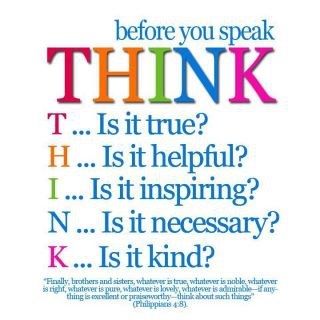

THINK

Proverbs 16:21-22

The wise in heart shall be called prudent: and the sweetness of the lips increaseth learning. Understanding is a wellspring of life unto him that hath it: but the instruction of fools is folly.

Think before you speakWise Words (v. 21)

Are you a person who thinks about every word that comes out of your mouth or do you just talk and think later about what you said?

I had a professor in college that, when asked a question, he would take several minutes to think about his words and then proceed to answer the question.

This drove me crazy! Even if he knew the answer right off the top of his head – he still thought about every word he said. His reasoning for choosing his words correctly is that he wanted to make sure the words he used explained the question in the best way possible.

My professor was wiser than I thought!

Get Understanding

So what exactly is understanding? Understanding is the ability to comprehend or grasp the true nature of something. It is the correct and proper analysis of a dilemma, event, or situation that sees all the angles and consequences.

God wants us to be people of understanding but true understanding can only come from God. Proverbs 2:6 says:

For the Lord gives wisdom; from his mouth come knowledge and understanding;

According to our verse, those who have understanding are like a wellspring or a fountain of life.

Lord, I pray that each and every day we would seek after YOU and your wisdom. I pray that you would show us how to use our speech for good and not to hurt others around us. Keep us in your care and help us to strive to understand you more and more.


Non-Verbal Communication

Proverbs 16:15

“In the light of the king’s countenance is life; and his favour is as a cloud of the latter rain.”

NON-VERBAL COMMUNICATION

Depending on which study you go on, somewhere between 60 and 93% of all communication is said to be “non-verbal.”  Along with the actual words heard, the listener is also processing the speaker’s inflection, facial expressions, gestures, posture, and a host of other context clues.  Most of the time, we process this non-verbal communication instinctively to arrive at the speaker’s total meaning.  Communication is complex, but God has gifted man’s intellect to sort through it all in the beautiful art of human conversation.

Today’s proverb is about non-verbal communication between the king and one of his subjects.  Perhaps the subject has been arrested and charged with a crime of a serious nature.  For whatever reason, the poor man is hauled in before the king.  As the charges are read, the subject dares not lift his eyes from the parquet marble floor of the throne room.   But then the defendant’s legal counsel urges him to look up at the king!  Trembling, he lifts his chin, and against all hope, he see the light of acquittal in the king’s eyes!  Overwhelmed with grateful joy, the king’s subject falls to the floor. With tears streaming, he thanks his king for granting him life.

STANDING BEFORE KING JESUS

Dear reader, one day soon you will face King Jesus.  It may be this very day, or it may be years hence. But God’s Word testifies that God the Father has granted to His Son the authority to judge the world with justice.  That this unique honor is given to Jesus is proven by God’s raising Jesus Christ from the dead (Acts 17:31).  What do you expect to see in the eyes of Jesus on that awesome day?  The light of life? Or will his face be full of wrath and the verdict of death (Proverbs 16:14)?

The gospel tells us that in His great love, God did the most amazing thing:  He sent His Son, the King, to earth to receive God’s wrath against the sin of man.  God has a measured, just, hatred of sin.  Sin cannot be ignored.  That’s why King Jesus went to the Cross!  To be the sin-bearer!

Now the gospel commands all men, women, boys and girls, from every nation, tribe, language and people group to repent of their sins and to receive Jesus Christ as Lord and Savior (Acts 2:38, 17:30).  The result?  That you will one day look into the eyes of your Judge, and there you see the loving eyes of your Savior—even the Lord Jesus Christ.

Father God:  In the countenance of your own dear Son, we see the light of life.  May his face shine in all of its glorious, merciful brilliance upon the reader this day.  Through Christ our Lord we pray: Amen. 


Keep Your Fingers to Yourself

Proverbs 16:14

“The wrath of a king is as messengers of death: but a wise man will pacify it.”

When I first read this verse I pictured an angry king who sent out soldiers to execute judgment on his enemies. Then, just a few days later, I learned of a more modern example of an angry king – Judge Jorge Rodriguez-Chomat. His kingdom? The Miami-Dade courtroom in Florida.

February 4, 2013

It was all caught on camera. The cheerful, giddy, 18-year old Penelope Soto stood facing a camera, while Judge Jorge Rodriguez-Chomat sat in the courtroom hearing her case. Soto was being sentenced for illegal possession of Xanax.

The judge seemed nice enough, trying to be patient Soto, who evidently didn’t take the whole thing too seriously. Then, when the judge set the girl’s bail at $5,000, she turned around and said in a casual, disrespectful way, “Adios!

Judge Rodriguez-Chomat said, “Come back…come back.” This time, irked at her flippant demeanor, he raised Soto’s bail to $10,000. That got her attention, too, and so this time when she walked away she held up her middle finger to the camera for the judge to see.

Come back! Come back!” said the judge. This time, after few words, he sentenced the once-perky illicit drug user to 30 days in jail. She quit laughing.

Don’t be a Fool

It’s really not that complicated. When one stands before one who has the ability to exercise judgment, it’s not very wise to air out one’s middle finger.

Penelope Soto could have gotten off with just a slap on the wrist. She seemed sweet enough, and the judge seemed patient, to a degree. But it was when she disrespected his authority that she crossed a serious line. That is when she experienced the “wrath of the king.”

Why is it that some people do that? Everything could be going just fine, then they choose to disrespect authority. Don’t they realize the foolishness of their actions? Why don’t they show a little wisdom and keep the “king” in a good mood?

They Don’t Respect God

The real reason most people have a problem with authority and end up ticking off kings is that they have no respect for God. If they did respect Him, they would respect His “minister.”

In Romans thirteen we read that we should “be subject to higher powers” (13:1). Anyone who resists, or rebels against authority is in danger of rebelling against God, “For there is no power but of God: the powers that be are ordained of God.”

Paul also said that if one does good, he should have no reason to fear authority. However, when we rebel, or show our middle fingers, we must remember if we do wrong, “be afraid, for he does not bear the sword for nothing” (13:4 NIV).


What Makes a King a King?

Proverbs 16:12

“It is an abomination to kings to commit wickedness: for the throne is established by righteousness.”

A king detests wrongdoing, for his rule is built on justice. (NLT)

I have never met an earthly king, but I have often wondered what makes a king a king, or a queen a queen. The history books tell us that many kings and queens built their rule not on justice and righteousness, but on evil and by instilling fear among their subjects. There are countries in our world that continue to be ruled in this way.

Jesus was born into poverty in a land ruled by terror. A foreign king ruled the land with the help of a local puppet king. Neither covered themselves in glory in the way that they ruled. Compare Caesar and Herod to Jesus. The fact that Jesus was different was evident after His arrest when He was interrogated by Pilate, the Roman governor for the province:

Pilate then went back inside the palace, summoned Jesus and asked him, “Are you the king of the Jews?”
“Is that your own idea,” Jesus asked, “or did others talk to you about me?”
“Am I a Jew?” Pilate replied. “Your own people and chief priests handed you over to me. What is it you have done?”
Jesus said, “My kingdom is not of this world. If it were, my servants would fight to prevent my arrest by the Jewish leaders. But now my kingdom is from another place.”
“You are a king, then!” said Pilate.
Jesus answered, “You say that I am a king. In fact, the reason I was born and came into the world is to testify to the truth. Everyone on the side of truth listens to me.” (John 18:33-38 NIV)

Did Pilate understand what Jesus was saying? Here was a King like no other. A King who is holy and perfect in every way that we are not. A King from another place who cannot be compared to any earthly ruler, but a King who considers every human welcome in His Kingdom. It is not us that this King judges, but our wrongdoing. His rule is built on justice, and the forgiveness made possible by His sacrifice.

Before Jesus all human beings are equal, and all are equally welcome. He hates the wrongdoing, but He loves the wrongdoer. What a King!


Responsibility of Leadership

Proverbs 16:10

“A divine sentence is in the lips of the king: his mouth transgresseth not in judgment.”

Oracle of God

If there was ever a puzzling verse of scripture, this could be it. At first glance it seems to suggest that a king is not only infallible in judgment, but the very words from his lips are divine. Is this teaching the “divine right of kings”?

Let’s look at the way two other translations treat this verse.

“An oracle is on the lips of a king; his mouth does not sin in judgment.” – Proverbs 16:10 ESV

“God’s verdict is on the lips of a king; his mouth should not give an unfair judgment. ” – Proverbs 16:10 CSB

I think we can derive two things from the comparative reading: 1) the king is not a god, but speaks as a mouthpiece for God; 2) if the words are from God, then they are true and fair.

But that still poses a problem, doesn’t it? Are all kings the mouthpieces of God? Are all kings incapable of speaking lies, untruths, or making poor judgments?

Of course not! As the late Matthew Henry said in his commentary on this verse:

We wish this were always true as a proposition, and we ought to make it our prayer for kings, and all in authority, that a divine sentence may be in their lips, both in giving orders, that they may do that in wisdom, and in giving sentence, that they may do that in equity, both which are included in judgment, and that in neither their mouth may transgress, 1 Tim. 2:1. But it is often otherwise; and therefore, 1. it may be read as a precept to the kings and judges of the earth to be wise and instructed.*

Accountable to God

In Romans 13:1-5 we read rulers are “ministers” of God put in place to “execute wrath on him that doeth evil” (verse 4). God has even used unbelievers, even ungodly kings and authorities, to bring about the punishment of evildoers and protect His people. That means that the king does not act as the ultimate authority, but as a servant to the true King.

There are those who may have considered the words of a king to be the final authority, as final as the words of God. However, the only words that are final and unchangeable are the words from God, and the king, at best, is only a mouthpiece, an oracle, charged with speaking wisdom from above.

Leadership at all levels, from kings to presidents, from policemen to senators, should keep in mind that they will one day stand before the throne of the King of Kings and give an account.

As a pastor, one charged with faithfully expounding the Word of God, that terrifies me even more. 


*Matthew Henry, Matthew Henry’s Commentary on the Whole Bible: Complete and Unabridged in One Volume (Peabody: Hendrickson, 1994), 990.


Mercy and Fear

Proverbs 16:6

“By mercy and truth iniquity is purged: and by the fear of the LORD men depart from evil.”
“In mercy and truth Atonement is provided for iniquity; And by the fear of the LORD one departs from evil.” (NKJV)

“He Could Break Me”

When I was young I had a healthy fear of my father. Even when I was a teenager, he was half again my size and could break me in two. The last thing I would have ever wanted was for my dad to strike me in anger, or worse, as an enemy. Thankfully, he loved me, especially when he “spared not the rod.”

Yes, my dad knew how to discipline in the old-fashioned way. He did not believe in “time outs.” Never once did he remind me to “make right choices.” If I made a wrong choice I found out about it real quick.

daddyBut the thing that I was most afraid of was not being punished by my dad for doing something stupid, it was breaking his heart. The worst punishment I could ever receive was to see a disappointed look in his eyes. I wanted him to be proud of me. I was more afraid of seeing a tear than getting whacked in the rear.

You see, my dad was a godly man…a simple man…a humble man…a very hard-working man. He worked multiple jobs, once even giving me his pay so that I could have work. He never raised his voice, but he could preach with authority. He was a true pastor, a faithful husband, and a friend to all. He did a lot for me that I will never know.

Proper Motivation

In today’s proverb Solomon speaks of mercy and forgiveness, but then he ends with “fear” being the motivation for correct behavior. What should be noted is that “fear” isn’t the kind of emotion that causes one to run and hide, but it is a profound sense of respect.

When we think of God, we should remember how merciful he has been to us. We should contemplate his goodness and grace. We should remember that He did not have to forgive us, but would have been completely justified to cast us into a burning hell forever, had it not been for Christ. When we remember these things we should fear and “depart from evil.”

But why should we depart from evil? Is it because of a fear that He will destroy us? No, for we are forgiven, if we have been covered in the righteousness of Jesus. We should have a profound respect for what God has done for us, not to us, and that fear should cause us to depart from evil.


Who’s the Boss?

Proverbs 16:3

“Commit thy works unto the LORD, and thy thoughts shall be established.” (KJV). 

The Secret to Success:

What is the secret to success? The world tells us that we just need to “be positive, focus, be persistent and work hard!” Is that all it takes? Or is there something else that we can do if we want to do well in life? Eugene Peterson paraphrases today’s Scripture with these words: “Put God in charge of your work, then what you’ve planned will take place.” (The Message).

Here are two important keys from the Scriptures that will help your plans to come to pass:

  1. Delight Yourself in the Lord:

Psalm 37:4 says, “Delight yourself also in the LORD; and he shall give you the desires of your heart.” If we want our thoughts to be established, and see our goals accomplished, the first thing we should do is spend time with God, and ask Him what His plans for our lives are. Too many Christians come up with their own ideas and plans and go to God and say, “Lord, will you bless my plans?” But those plans are not always His will for our lives, and so He may not bless them.

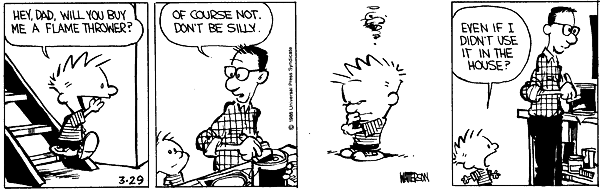
One of my favourite comic strips characters Calvin, from Calvin and Hobbes went to his dad and said, “Will you buy me a flame thrower?” His response was, “No.” Does that mean that his dad didn’t love him? Of course not! But he knew his son well enough to know that if he gave into his request, it would have disastrous consequences. So, if we want to see our thoughts established, we must first spend time with the Lord and ask Him what He wants us to do.

This is one of the reasons why the ministry of Jesus was so successful. He only did what the Father told Him to do! Jesus said, “The Son can do nothing of Himself, but what He sees the Father do.” (John 5:19). I was in ministry for several years before I learned this important principle: Instead of going to God with my plans and saying, “Would you bless them?” I now go to God and say, “What’s your plan for today, Father?”

  1. Walk in Obedience:

If we want God to see our plans succeed, we need to walk in obedience to the Lord. The first part of that is obedience to the general will of God as recorded in the Scriptures. James 1:25 says, “But he who looks into the perfect law of liberty and continues in it, and is not a forgetful hearer but a doer of the work, this one will be blessed in what he does.” The second part is obedience to the specific will of God for our lives, which is revealed to us in prayer. God has blessed us to be a blessing – who does He want you to bless today?

What is God calling you to do? Do it and it will be blessed!

Calvin & Hobbes - flame thrower

(Calvin & Hobbes (c) 2013 Bill Waterson).


Are You Afraid?

Proverbs 15:33

“The fear of the Lord teaches a man wisdom,
    and humility comes before honor.”

What is Fear?

We see lots of mention of fear in the Old Testament. It’s a word that doesn’t fit well with our modern mindset, and so many people who speak about these verses reduce fear to something else. They tell us it is more like awe or respect. Yet even these words have been diluted by our present culture.

When I was a child and did something wrong, I feared the consequences, I feared my parents and the discipline they would bring, the telling off I would receive. Today children seem to fear very few things, and the ideas of respect and awe are replaced by individualism.

Real Fear

But what if fear means fear? What if there is reason to fear God, and this reason makes the grace He shows us all the more amazing?

In the Old Testament the Israelites were afraid to approach the mountain that God met Moses on, Jacob comments on how he came face to face with God and lived.  Maybe fear is the beginning of all wisdom because when we realize that God could do anything He wants at any time, He could make our lives miserable and full of suffering, He could punish us for our sins.

And yet he doesn’t.

Instead He pours grace upon us, and in Jesus shows us how humility comes before honor.


The Cost of Bribes

Proverbs 15:27

“He that is greedy of gain troubleth his own house; but he that hateth gifts shall live.” 

“A greedy man brings trouble to his family, but he who hates bribes will live.” – NIV

Same Script

Have you ever noticed how most crime dramas on television are the same, at least in the writing department? When we read in Ecclesiastes 1:9 that there is “no new thing under the sun,” it especially applies to television and movie plots.

One reason that it is hard to come up with anything new is because men keep doing the same things over and over again. The stories are all so similar in pattern because the template is ingrained in man’s fallen nature. He keeps falling for the same old tricks every time, like fish that never question a swimming worm.

One common story line involves a man who needs money, takes a bribe, gets caught, then brings his family to ruin. It varies, of course, but whether it’s a politician who takes a bribe in order to keep his career afloat, or a discouraged policeman who deals confiscated drugs in order to take care of his sick children, the end is always the same – trouble.

Doing What’s Right

It is not always easy to turn down easy money. Sometimes the offer can seem pretty tempting. Several years ago my wife and I were asked to hire undocumented workers in order to keep down the costs of a cleaning contract. We were told over and over, “They work hard for little money…everyone does it…no one will find out.” We could have saved thousands of dollars in labor costs.

Doing what is right, however, is more important than money. Greed is the downfall of many. What would have happened my wife’s company had been visited by federal agents? How many lies would she have been responsible for when she filed payroll taxes? What would have happened to our family of one of us had been sent to jail?

Even when times are at their worst, doing wrong, taking a bribe, doing it for the money, is never good for one’s home. Somebody down the line will pay for poor choices made.