Author Archives: Anthony Baker

About Anthony Baker

Unknown's avatar
Husband, dad, pastor, artist, and musician. Time Magazine's Person of the Year in 2006 (no joke!). Loves coffee (big time), good movies, and sarcastic humor. Holds a Doctorate in Ministry. Most importantly, a servant of the Lord Jesus Christ. All glory belongs to Him! Matthew 5:16

Planning Evil? You’re Messing Up.

Proverbs 14:22

“Do they not err that devise evil? but mercy and truth shall be to them that devise good.”

 A Silly Question

Sometimes a question is so simple it shouldn’t have to be asked. A good example is when one person loses an arm in a freak juicing accident and another asks, “Are you hurt?”

Many, many years ago I was pretty good at martial arts, so I participated in tournaments from time to time. In one tournament I had made it all the way to the final round in a point-fighting competition and received a spinning heal kick to the side of my head. Down to the floor I went.

Lying there on the floor, I experienced the strangest sensation: I saw blue. When the referee came over to me and knelt down she asked, “Are you OK?” I said, “Uh…no…I see blue.” I thought to myself, “What a funny question to ask someone who just got kicked in the head!” However, I did recover in the allotted time and actually won the fight (yay me!).

Aren’t They Messing Up?

This proverb asks a question about foolish people that “devise” or plan evil: “Do they not err?” In other words, is it not so that those who devise evil plans are always messing up? Of course! What a silly question!

Well, it’s not too silly, or more people would learn from their mistakes. It sorta reminds me of villains on crime dramas; don’t they know the hero always wins?

Have you ever watched the Road Runner and Coyote cartoons? Correct me if I am wrong, but you could have asked the question of this proverb every time Wile E. Coyote placed an order in to ACME. His evil plans NEVER worked.

The Hero Will Win

Do they not err? Aren’t they messing up win they plan their evil, rascally schemes? Yes, because the Hero will win. It may not be in this life, but all those who devise evil will suffer. They will lose.

Those who devise good are going to be the ones that are OK. Mercy and truth will be theirs. And what’s more, when the Hero wins, they will be on the winning side, too.


Friends and Neighbors

Proverbs 14:20

“The poor is hated even of his own neighbor: but the rich hath many friends.”

Definition of a Neighbor

An expert in the law once asked Jesus the question: “Who is my neighbor?” This man knew that the law told him to love his neighbor, but while the purpose of the question was to test Jesus, it is doubtful that he was head over heels in love with all his neighbors. So Jesus told a story and put the expert in the law on the spot. The story involved a Samaritan, a person the expert in the law was least likely to want as his next-door neighbor. At the end of the story the legal expert begrudgingly accepted that out of three people, the Samaritan was the only true neighbor to the injured Jew in the illustration provided by Jesus. The mercy, compassion and love showed by the Samaritan enriched him as the giver, and the injured Jew as the receiver. It must also have enriched the innkeeper.

Poor Neighbor or Good?

While mercy, compassion and love bring enrichment, the process of hating another human being brings impoverishment to all parties. Hate is a strong and unpleasant word, but if there is a person or group of people we despise, don’t like, disrespect, look down on, etc., then is that any better than hate? What gives us the right to judge ourselves better than another human being? Are we good neighbors or poor neighbors? Are we rich in mercy, compassion and love? Should we be friends of the rich or good neighbors to the poor?

Who are Your Friends?

It is said that we can choose our friends but not our families. Similarly, it is not possible to choose our neighbors, especially if we consider how Jesus defined neighbors. Jesus quite deliberately spent much of his time with the impoverished of society, rather than with rich people, famous people, or clever people. His friends were fishermen, prostitutes, tax collectors, and the like. Jesus wasn’t intimidated by learning, wealth or position, He looked at the heart. So when a rich young man asked Jesus what he needed to do to be saved, Jesus told him to sell everything and give the proceeds to the poor. By enriching the lives of others in this way this young man would have become wealthy in a different way, with riches that would last forever.

Who is your neighbor?


Knowledge Looks Good On You

Proverbs 14:18

“The simple inherit folly: but the prudent are crowned with knowledge.”

Making a Deal

When I was young, there was a very popular game show on television called Let’s Make a Deal. One of the most popular aspects of that show was the opportunity given to contestants to choose their prize. They could choose between what they were initially given, or take a risk and exchange it for something else…usually behind “curtain number 1.”

More often than not, the contestants would choose to take the risk – and it was a risk – and surrender what was in hand (even though they may have not know what that was, either) for whatever was hidden behind one of several curtains.

And, more often than not, as far as I can remember, the contestants usually ended up with something pretty silly, like a lifetime supply of toothpicks. On the other hand, there were those who made bank. “You just won a brand new car!

For those who wanted to take a risk and play the game, the outcome was still better than having never played at all.

But let’s just imagine if the “simple” person in this proverb was on a similar game show. What might we see?

“Let’s Get a Crown!” 

Imagine the simple man of this verse traveling to Hollywood to compete on Let’s Get a Crown!. Imagine him being selected from the crowd and being asked to “come on down” to the front to stand with the host.

After being selected as a contestant, Mr. Simple is given a small prize – a gilded toilet bowl plunger. Then, after a laugh, the game show host offers Mr. Simple a few curtains from which to choose, noting that behind each is a prize far more grand than the one already in his possession.

Host: “Sir, all you have to do is trade that gilded plunger for one of those curtains, and I guarantee, regardless of your choice, the prize will be far more valuable. Which do you want to choose?”

Mr. Simple: “Well, Bob, I think I’ll just keep my plunger.”

Host: “What? You could trade that plunger in for a chance at much greater things! Surely you’d rather walk out of here with a prize to be proud of, wouldn’t you?”

Mr. Simple: “Nah. I have what I have. It’ll do. I’m not leaving empty-handed, so why ask for anything more?”

Choose to Learn

We could approach Proverbs 14:18 from several different directions, but the one I would like to take is that of one who settles with ignorance rather than striving for knowledge.

Consider the word inherit in the first part of this proverb. It is in the “perfect tense,” which means the inheriting of folly is a completed action – it’s done.

The word crowned in the second part is different; it’s in the “imperfect tense.” In other words, it’s an on-going thing, not something that is finished.

The simple – the foolish – are content with what they know and are content in their ignorance.

However, the prudent understand the value of learning and are not content with the gilded plunger of ignorance! They are ever expanding the substance of their inheritance and continue to add to their estate and wear a crown to prove it…

…much like those who come here to learn a little more about God’s Word.

Knowledge looks good on you 🙂 


Don’t Be Gullible

Proverbs 14:15

“The simple believeth every word: but the prudent man looketh well to his going.”
Ah, the Stories…

There are so many stories I could tell about the stories I can tell. To paraphrase a saying, “So many stories, so little time.” Therefore, when I read this proverb, I immediately began to think of a couple of good examples.

Example One:

Back in the 1990’s I worked in the sporting goods section of a major retailer. One day a couple asked for my advice about a football. They wanted to know which would be better to buy, the one made of leather, or the one made of “Durahyde,” a synthetic, man-made material.

For some reason I started with this nonsense about how the Dura was going extinct and how only the young duras were used because of their fur-less pelts. The more I talked, the more they seemed to believe me, so a vicious circle of humor-gone-bad and gullibility took over.

“So what do you recommend?” they asked. “Buy the leather,” I suggested. “It might be a little more expensive, but I just can’t approve of the way they kill those young, little duras for their pelts.”

The more I talked the more it became evident that some people will believe anything, no matter how outrageous. In retrospect, I am ashamed that I forgot to tell them I was only kidding.

I was just so stunned that they actually believed me! (Note: the leather ball was the better choice, and that was what they wanted.)

Example Two:

It was a Christmas dinner, and my mother-in-law (we could stop right there, I suppose) was complaining that someone had made meatloaf. “Why did [she] make meatloaf? Since when was meatloaf a traditional Christmas dish?”

“Well,” I said, “meatloaf is a very traditional Christmas dish, as a matter of fact.” “Really?” she asked. “Yes, it goes way back to around the year 1260 in England.” I went on to tell her that long ago there was a good king who prepared a great feast for all the peasants in his kingdom. Each Christmas he would invite all of them to come in and take part in a Christmas meal, the centerpiece being a large animal cooked over a fire.

As the story went, one year things got really bad. There was great poverty throughout the land, and when it came time for the annual Christmas feast, the king had no cattle, dear, or any such animal to offer. Saddened, the people of the local villages rallied together and decided to save the good king from embarrassment. They killed and cooked chicken, rabbit, and pheasant, combined them all together in to a large “loaf,” and offered it as a gift to the king who had been so good to them.

I told my mother-in-law, “That is why meatloaf is probably the MOST traditional of all dishes served at Christmastime.” “Is that so? I never knew that! Wow!” was her reply. “I guess I shouldn’t have gotten so upset,” she said (Then my wife had to spoil everything by telling her I was only joking).

Be Prudent

I believe Solomon was the first to say, “Don’t believe everything you read, hear, or see on television.” He did say that, didn’t he?

Don’t get me wrong, I love to joke around with people, but I hate lying. My stories are meant to eventually be understood as told in fun – like a grandfather who insists he has pulled a quarter from your ear. Nevertheless, it’s better to follow the words of Paul and “prove all things” (1 Th 5:21).

The gullible believe everything without question, and there are those who will take advantage of them. The prudent (wise), therefore, learn to check sources.

Let God be true, and every man a liar (Romans 3:4).


I’d Rather Live In a Tent

Proverbs 14:11

“The house of the wicked shall be overthrown: but the tabernacle of the upright shall flourish.”

House vs. Tent

There is a huge difference between a house and a tent. At one point in our marriage, my wife and I actually contemplated buying a nicer tent (one with rooms) and living in it during the summer. We briefly wondered if doing that could help us save money, as opposed to renting a house. The only problem with that was air-conditioning and running water – a tent has neither.

Another thing or two that a tent does not have are solid walls, doors, outlets for electricity, and appliances for washing clothes and cooking food. A tent is not the kind of dwelling you want to hang pictures inside, either. Tents are not meant for long-term, settled living; they’re only good for temporary stays, like at the lake, or in one’s back yard while on a dinosaur-hunting safari.

Houses are solid buildings meant to last. They are meant to be left for an inheritance  They are meant to be places where roots are dug deep and social identities are made. They are ideally meant to become permanent homes. Tents are for pilgrims.

Conventional Wisdom

Conventional wisdom leads one to believe that the more sturdy a house is, the better the investment. Conventional wisdom says that a tent is not the kind of dwelling in which to raise a family and secure a future. But when we are talking about the wicked and the upright, conventional wisdom is worthless.

Conventional wisdom teaches that in order to have longevity and a solid future, one which will insure one’s name is passed on from generation to generation, one must be tied down to the world. It makes no sense, therefore, to rest at peace in a temporary dwelling, like a tent, which is what the word translated “tabernacle” means. But godly wisdom is anything but conventional.

Godly Wisdom

In this proverb the writer wants us to understand that in order to “flourish” and grow we must be pilgrims in this world, not “house builders.” The “house” of the wicked will never be as secure as the temporary “tabernacle” of the righteous.

The Apostle Paul said, “If ye then be risen with Christ, seek those things which are above, where Christ sitteth on the right hand of God. Set your affection on things above, not on things on the earth” (Colossians 3:1-2). Followers of Christ are “strangers and pilgrims” on this earth (Hebrews 11:13). The upright knows this world is not his final home, therefore he is always ready to pull up stakes and move.

Storm Shelters

If you have every been in a severe storm, you understand the value of a storm shelter. Storm shelters are meant to be ultra-strong and immovable. But when it comes to the teaching of this proverb, the opposite is true. When it comes to the storms of life, the one that will be overthrown is the one who is tied down to the world. The pilgrim living in a tabernacle (tent) will not be swept away, but “flourish.”

When the worst weather of life comes, it is better to dwell in the flimsiest, most temporary structure built by God, than in the strongest, most secure castle built by man.


Walk Away from Stupid

Proverbs 14:7

“Go from the presence of a foolish man, when thou perceivest not in him the lips of knowledge.”

Product Labels

Some proverbs, such as this one, are pretty simple and straightforward. But on the other hand, as some product warning labels make abundantly clear, what should be obvious to most needs to be spelled out to others. Here are some examples:

  • “Don’t drive with shade in place” (warning on inside of cardboard sunscreen).
  • “Not for drying pets” (warning for microwave).
  • “Surface may be hot when turned on” (stove instruction manual).
  • “May cause a fire” (warning on box of matches).

If there were no stupid people in the world, the above warnings would be unnecessary. However, I am sure there have been people amazed when their hands were burned on a stove eye or by a match. I am positive that someone tried to sue a company because the microwave killed her wet cat.

Stupid People

In this proverb God has placed a warning label on stupid people. Yes, I said “stupid” people, for that is what the word translated “foolish” (סִיל kesil) actually implies.[1] The Lord wants us to know that it is not good to just stand and listen to what fools have to say, especially when you realize that what they are saying is void of any knowledge.

So, to put this proverb another way, “When you find yourself in the presence of a stupid idiot, don’t bother listening to what he has to say; walk away.”

Now, it may seem ridiculous to make such a statement, but consider why it is important to not listen to what a fool has to say:

  • A fool does not accept instruction, so arguing with him is pointless.
  • A fool would love to frustrate you and make you angry as you try to argue your point.
  • If you listen to a fool long enough you might begin to believe the stupidity he preaches.

A Prayer

Lord, we need wisdom to be discerning. Help us to recognize those who lack words of knowledge. Help us to know when to contend and when to walk away. Help us to know the difference between a fool and someone who is open to the truth.


[1] Francis Brown, Samuel Rolles Driver and Charles Augustus Briggs, Enhanced Brown-Driver-Briggs Hebrew and English Lexicon, electronic ed. (Oak Harbor, WA: Logos Research Systems, 2000), 493.


A Fool and His “Switch”

Proverbs 14:3

“In the mouth of the foolish is a rod of pride: but the lips of the wise shall preserve them.”
“A fool’s talk brings a rod to his back, but the lips of the wise protect them.” – NIV

Pick Your Own

If the typical Child Protective Services agent of today had been around when I was a wee heathen, my parents, grandparents, and great-grandparents would have been hauled off to jail. My parents, especially my paternal grandmother, would have wound up on the front page of the newspaper. They would have made the evening news on television. The story would have read something like this…

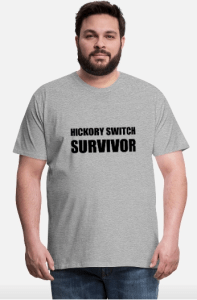
Click on the picture. I’m sure the company won’t mind me doing a little advertising in return for using their t-shirt pic 😉

APNews. Mary Baker, the half-Cherokee grandmother of sweet little Anthony Baker, was arrested for gross child abuse, today. Mrs. Baker, widow of the late William Baker (saw mill owner; moonshine runner), was found to have left marks on cute little Anthony’s backside and buttocks with a “hickory switch.”

Left-wing, pot-smoking, tree-hugging, liberal, hippie neighbors who somehow snuck into the neighborhood heard little Anthony screaming bloody murder and went to investigate. They reported seeing darling little Anthony bent over his grandmother’s knee as she mercilessly assaulted him with the large tree branch previously growing in the front yard.

According to the angelic little Anthony, his grandmother, upon hearing him backtalk her, told him to exit the house in order to retrieve said “switch.” When he didn’t return with the prescribed tool of abuse, Mrs. Baker sought him out, hewed down her own tree, then preceded to “wear him out.

Yes, when I was a child, you did not talk disrespectfully to your grandmother. If your mouth was bad enough you might even be made to pick your own tool of discipline – and it was wise to pick a big enough switch the first time.

A Fool’s Talk

Whenever I was about to get into serious trouble, my dad used to say, “Son, you’re cruising for a bruising.” Whenever I talked back (disrespectfully) to my parents, I was in danger of seeing stars (without a telescope). Therefore, it did not take long for me to learn how to control my tongue.

According to this proverb, though, a fool is pictured as having a rod (switch, branch, vine) growing out of his mouth. Because of his pride, the fool never learns from the consequences of his words. Every thing he says seems to come back and beat him.

The one who knows how to keep his mouth shut, however, is much more likely to be able to sit down without pain. At least that’s the way it used to be.

A Note for the Shocked

Please don’t misunderstand today’s proverb, nor my attempt at humor. No one here, especially myself, would advocate abusing a child. Corporal punishment should be administered in love, not anger, and only as a last resort.

The problem is that much of our society promotes “the mouth of the foolish.” Remember, “God is not mocked,” so the fool that runs off at the mouth today is still in danger of suffering from his words – one way or another.


Little Is Much

Proverbs 13:23

“Much food is in the tillage of the poor: but there is that is destroyed for want of judgment.”
“A poor man’s field may produce abundant food, but injustice sweeps it away.” NIV

We Complain 

Many times we complain about what we don’t have rather than thank God for what we do have. Have you ever complained about how small your house is, how old your car is, or how out of style your clothes are?  Sure you have. And you know, of course, that there are plenty of people out there who don’t even have a roof to sleep under, much less a new car or stylish clothes.

It might be a shock to you, but even pastors (ministers, preachers, bishops) have times when they complain about the “field” they are called to plow. I have done it. I even did it today, right before I read Proverbs 13:23.

We Whine

Today [at the time of this writing] we had a death in our church. The loss of this key member has been a blow to all of our congregation. And being that our numbers are small, the loss of any member is painful, especially when growth has been extremely slow.

At one point I began to feel anxious. I asked God, “How can we grow a church if our younger adults start dying?” I thought to myself, “If we lose many more, we won’t be able to pay our utility bills, not to mention the little I get to feed my family.” For a moment I considered this field too small for even a minimal harvest.

No Excuses

Then I read this proverb. Then I read what the wise Matthew Henry had to say. Then I felt ashamed.

See…[how] a small estate may be improved by industry, so that a man, by making the best of every thing, may live comfortably upon it: Much food is in the tillage of the poor, the poor farmers, that have but a little, but take pains with that little and husband it well. Many make it an excuse for their idleness that they have but a little to work on, a very little to be doing with; but the less compass the field is of the more let the skill and labour of the owner be employed about it, and it will turn to a very good account. Let him dig, and he needs not beg.[1]

Sounds like I need to just get back out in the field and turn the soil, doesn’t it? A small field can be full of produce if worked well and wisely. It is those who complain that let a harvest waste away.

Like the old song says, “Little is much when God is in it...”

Dear Heavenly Father, strengthen our hands and energize our hearts for the work. The fields are truly white unto harvest, so who are we kidding? We just need to work a little harder to bring it in.

[1] Matthew Henry, Matthew Henry’s Commentary on the Whole Bible: Complete and Unabridged in One Volume (Peabody: Hendrickson, 1994), Pr 13:23.


Honored On a Box

Proverbs 13:18

“Poverty and shame shall be to him that refuseth instruction: but he that regardeth reproof shall be honoured.”

Cracker Jack Boxes

Years ago I had a great sales manager, Dennis Vauvrunek.  He was great because he was a servant leader; because he was an encourager; and because he tried to bring out the best in his people.

Dennis knew that sales people are competitive by nature. So, in order to showcase the person with the highest numbers each week, he gave away an award – a box of Cracker Jacks.

Now, this was not just any box of Cracker Jacks, but one that had printed on the front the name of the winner and the dollar amount sold. It was amazing how much harder some of us would work when we though someone else might get the box. Sometimes getting that box was more important than a paycheck.

Honor and Reproof

The key to the success of the Cracker Jack box was the natural desire to be honored. The one who received it was considered the “best of the best”…a “go-getter,”…a winner.

But success in any field does not come by accident. Hours and hours of instruction, hands-on training, and learning from one’s mistakes were a prerequisite to being successful. The winners of Cracker Jack boxes were men and women who had been humble enough to accept reproof.

Poverty and Shame

Those who never accept instruction, much less reproof, are usually destined for poverty. Poverty and shame are the wages of pride.

When the industry I was in was active, I made really good money. But making a good living came as the result of dedicated, systematic, hard work. When I trained others to do what I did, I would show them exactly what was needed to be successful. All they had to do was follow my instructions. Those who didn’t went broke. Those who wouldn’t take advice never met their quotas. It didn’t take long before they were gone.

Your Name on a Box

Do you want to succeed in a particular area of life? Do you want to provide for yourself and your family? There is a price to pay. You must be humble.

1 Peter 5:5-6 – “Likewise, ye younger, submit yourselves unto the elder. Yea, all of you be subject one to another, and be clothed with humility: for God resisteth the proud, and giveth grace to the humble. Humble yourselves therefore under the mighty hand of God, that he may exalt you in due time.

What kind of box do you want?


The Hard Way

Proverbs 13:15

“Good understanding giveth favour: but the way of transgressors is hard.” KJV
“A person with good sense is respected; a treacherous person is headed for destruction.” NLT

 A Hard Life

Every now and then you may encounter people with a look that older than than their age. You may meet a man who is only in his thirties, but looks like he over sixty. A young woman may cross your path that is wrinkled, bent over, and haggard, only to find out that she is 28 years way too old.

What makes people look like they are much older than their chronological age? Hard lives. Lifestyles bent on destruction.

To be fair, there are others that you may see who have been through a lot of pain and suffering due to circumstances beyond their control. These, too, may look older than they actually are. Life has been hard on them. But for many, what they have endured has been the result of a transgressor’s path, and that’s a hard road.

Good Sense

A person that exhibits good sense (“understanding”) is typically a person who takes better care of himself. Good sense says, “Hey, maybe staying up late every night partying until the sun comes up is a bad idea.” Good sense says, “You know, taking that drug might be harmful, not to mention addictive.

Someone with understanding and good sense is also somebody others respect and trust. For example, this type of man or woman is the one who gets the job or promotion. He or she is the one who gets awards and bonuses. They are also the ones who have lower life insurance premiums and rarely have to pay large down payments to purchase anything on credit.

However, the transgressor is the one who nobody really trusts closing the store at night. He’s the one who always calls in sick on Monday morning. Life insurance companies consider him a “high risk” and deny him coverage. And when it comes to buying a house or new car, all he can do is rent.

Advice for the Road

Let me give you some advice. If you are planning on traveling down the “hard road” of life, plan on things never going your way. But don’t think you can blame all of your woes on those with more than you, because they have “understanding;” they can see through your schemes.

Don’t blame the government. Don’t blame the church people. Don’t blame your boss (if you can keep one). Don’t blame anyone for the path that you have chosen.

Also, if you are planning to live a life that transgresses God’s word (His law), don’t blame Him when things don’t go the way you plan. He warned you.

So, when you find yourself living in a run-down motel, remember, Wisdom has been crying out, “You simple people, use good judgment. You foolish people, show some understanding” (Proverbs 8:5 NLT).

When you won’t listen to Wisdom, your way will be hard.